
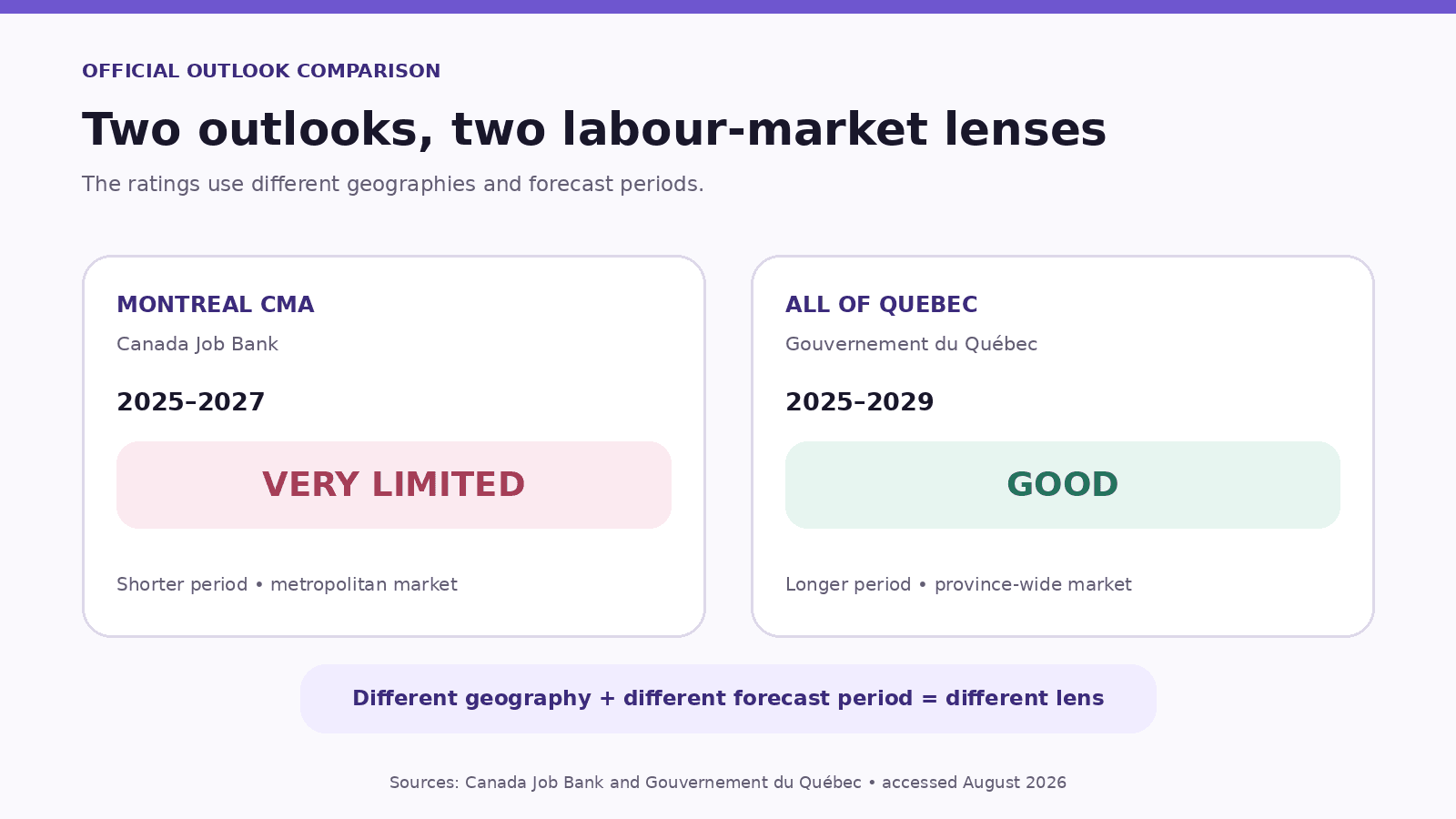
If you are researching the graphic designer job market in Montreal, the honest answer is that design work still exists—but securing a salaried role is difficult right now. Canada’s Job Bank rates the Montreal outlook for graphic designers and illustrators as Very limited for 2025–2027. At the same time, the Quebec government rates the occupation’s outlook as Good across Quebec for 2025–2029.
Those findings are not necessarily contradictory. They cover different geographies, forecast periods and labour-market models. Montreal has active design work, but its immediate hiring market is competitive and openings are limited. Designers improve their chances with sector-relevant evidence, business understanding, production knowledge and an ability to work with changing tools—including AI.
Montreal’s short-term outlook is difficult
The federal Job Bank outlook for Montreal assigns Very limited prospects to graphic designers and illustrators, NOC 52120, for 2025–2027. That rating is a warning about the likelihood of finding employment in this occupation and region during the forecast period. It does not mean that no one will hire a designer.
The Quebec government provides a broader view. Its occupation profile, last updated June 19, 2026, rates prospects as Good for all of Quebec for 2025–2029 and reports approximately 21,000 people employed in the occupation in 2024. It also shows that graphic designers and illustrators work across several sectors: specialized design and related professional services account for 24% of employment; information and cultural industries, 21%; computer systems design, 12%; advertising and related services, 8%; and arts, entertainment and recreation, 6%. Gouvernement du Québec occupation profile
Data note: The Montreal rating covers one metropolitan labour market and a 2025–2027 period. The Quebec rating covers the whole province and a 2025–2029 period. Neither rating should be substituted for the other.
The contrast suggests that mobility matters. Opportunities outside a narrow “graphic designer” title may appear in digital products, communications, cultural production, specialized design and interactive media. Provincial growth may also be distributed unevenly and not translate into easy hiring in Montreal today.
Why job postings can exist while finding work remains hard
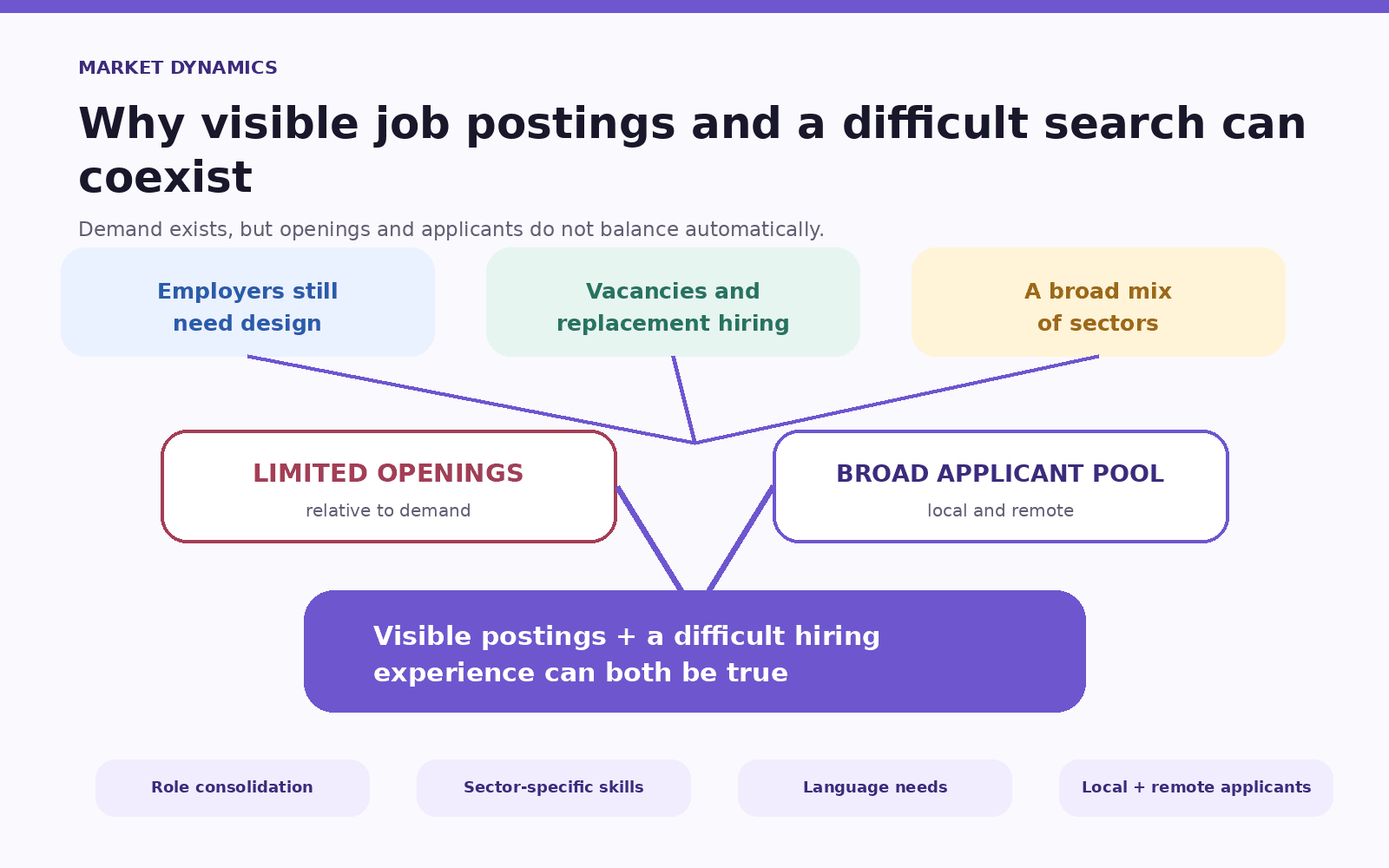
A person can see fresh listings and still experience months of unsuccessful applications. A posting page is a changing snapshot; an outlook rating estimates broader conditions over several years. One vacancy might replace someone who left rather than represent growth, and it can attract local and remote applicants.
Job Bank gives unusually direct context for the competition: its Montreal outlook says there are “several unemployed workers with recent experience in this occupation.” It does not publish an exact number of Montreal applicants, so the evidence supports describing competition as high—not claiming that everyone is unemployed or attaching an invented applicant count. On August 22, 2026, Job Bank’s live local snapshot showed 11 openings for illustrator and graphic-designer roles near Montreal. That count will change as listings open and close. Job Bank local openings
Counts from broader job boards may be higher because they can cover a wider radius, adjacent job titles, reposted vacancies or the same role syndicated by multiple sources. They are useful for finding leads, but they should not be treated automatically as a count of unique new graphic-design positions.
The official NOC 52120 profile spans graphic design, illustration and related work across print, advertising, film, digital and interactive media. Similar titles can therefore require different combinations of brand, production, motion, web, 3D or client-facing skills.
This creates four pressures at the same time:
- Openings are limited relative to the applicant pool. A small number of visible postings does not mean the market can absorb every qualified designer.
- Applicants are not competing for identical work. A strong branding portfolio may not prove motion, production or digital-product ability.
- Employers can ask one role to cover several functions. Current postings commonly combine design with content production, multimedia, coordination or technical tools.
- Portfolio quality is only one screening factor. Language readiness, relevant sector experience, collaboration, deadlines and file-production knowledge can affect the decision.
There is no credible basis for claiming that immigration or one government policy “killed” graphic-design wages. Workforce changes are part of the context, but the cited data does not establish that causal relationship. Competition can also reflect economic conditions, employer budgets, remote applicants, graduate supply, role consolidation and technology.
Graphic designer wages in Montreal vary widely
Job Bank’s Montreal wage report lists a low, median and high hourly wage of $20.00, $32.69 and $62.56, using a 2023–2024 reference period. These figures describe the distribution of reported wages; they are not guaranteed starting rates. Job Bank wage report
The Quebec government’s province-wide profile reports $20.00, $32.00 and $52.88 per hour, calculated from 2023–2025 wages. The small difference in medians and the larger difference at the high end are another reminder to check geography and methodology before comparing numbers.
Compensation changes with:
- sector and employer size;
- employment status and seniority;
- specialization in areas such as motion, interactive media, packaging or production;
- technical breadth and speed of execution;
- language and client-facing requirements;
- benefits and guaranteed hours.
An hourly wage cannot be compared directly with a freelance rate, which must also cover non-billable time, software, equipment, taxes and gaps between projects. This article concerns employment positioning, not project pricing.
AI is changing design tasks, not proving that designers are unnecessary
AI can already generate images, resize assets, suggest layouts, remove backgrounds, summarize briefs and accelerate variations. That affects how some production work is completed. It does not prove that an employer can remove design judgment, brand responsibility, accessibility, stakeholder alignment, rights review or production oversight from the process.
Statistics Canada’s June 2025 analysis found that 12.2% of Canadian businesses had used AI to produce goods or deliver services during the previous 12 months, up from 6.1% one year earlier. Among businesses that used AI, 89.4% reported no change in employment levels after implementation. More common responses were developing new workflows, reported by 40.1%, and training current staff to use AI, reported by 38.9%. Statistics Canada, June 16, 2025
More recent Statistics Canada research, published March 25, 2026, found that occupations in selected cultural industries may have relatively high exposure to AI-related transformation. The study identified potential for both substitution and augmentation, and warned that slower employment growth observed in some cultural industries could not be attributed to AI alone because other economic forces and earlier trends may also be involved. Statistics Canada, March 25, 2026
The practical response is to show where a designer adds accountable human value rather than compete at producing the fastest generic output.
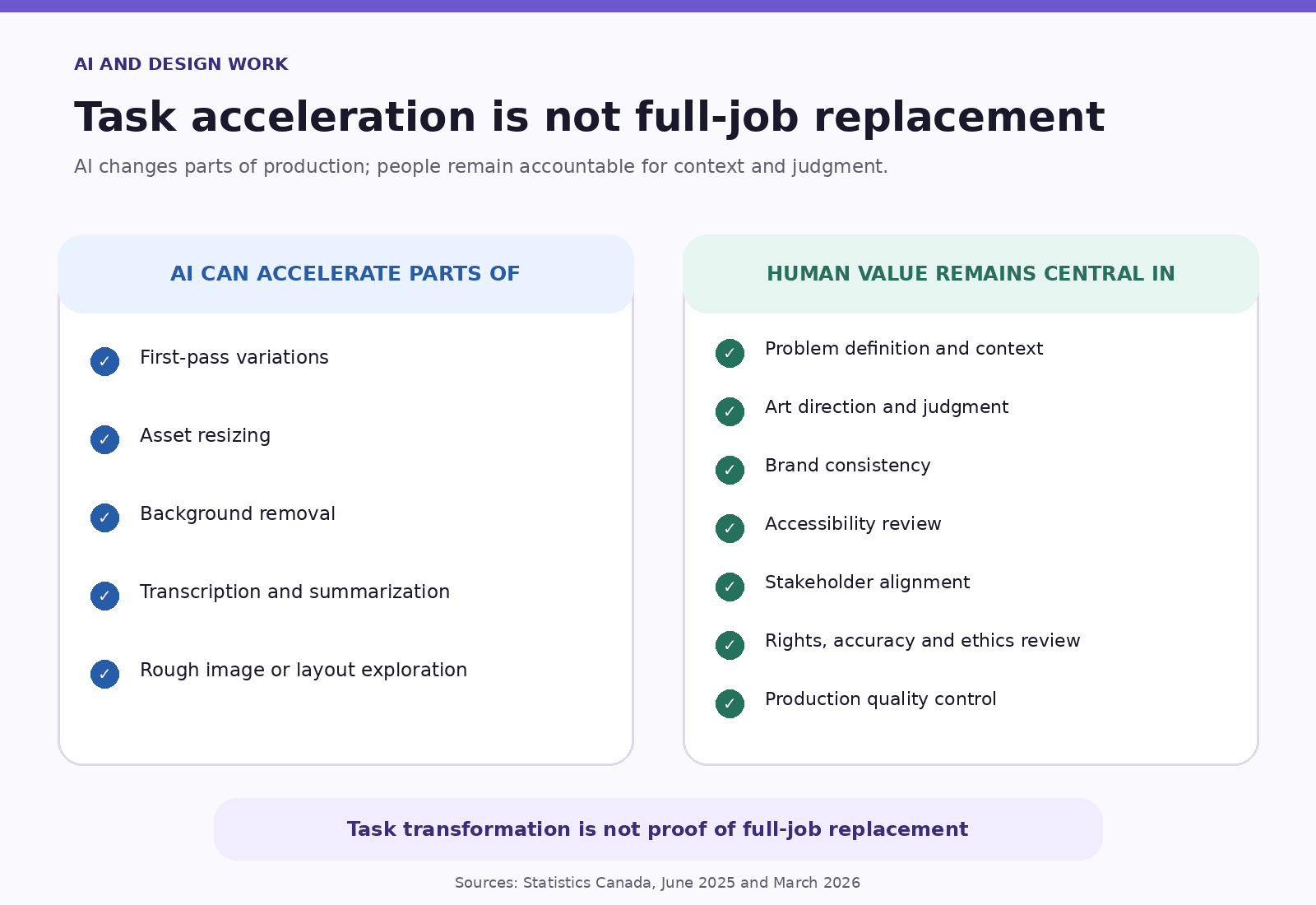
AI may accelerate exploration, variations, background removal, transcription and resizing. Human responsibility remains central to defining the problem, interpreting context, choosing direction, protecting consistency, checking accessibility, aligning stakeholders, reviewing rights and accuracy, and judging whether the result works.
Employers expect evidence beyond attractive visuals
The official NOC describes duties including client consultation, layout development, estimating cost and time, integrating typography and imagery, coordinating production and collaborating with other professionals. Quebec’s profile also identifies adaptability, teamwork, attention to detail, design and communication knowledge, and French–English bilingualism among relevant attributes.
A small sample of Montreal-area Job Bank postings captured in June and July 2026 reinforces the breadth of expectations. One Saint-Laurent graphic-design listing referenced Photoshop, image-editing and 3D software. A Montreal graphic-artist listing named Photoshop, PowerPoint and Adobe XD. An Outremont listing named InDesign, Illustrator, Photoshop, After Effects and Premiere Pro, along with five years of Illustrator experience. These examples are a directional sample, not a representative survey of every employer.
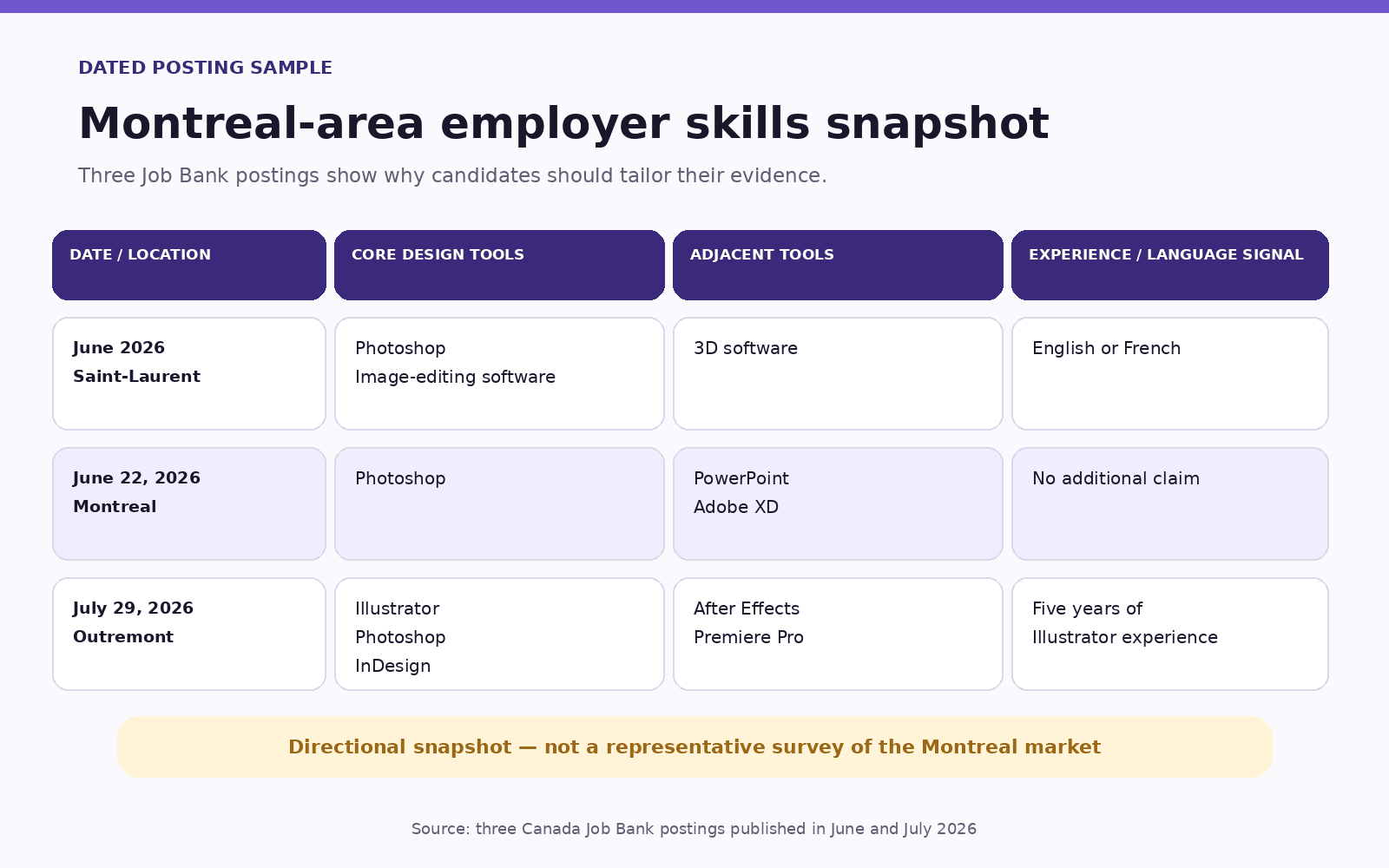
Candidates should avoid presenting a software list without proof. A stronger case study explains the problem, role, constraints, decisions, deliverables and result. Zahra’s selected graphic-design and digital work provides one example of organizing project evidence instead of showing disconnected images.
How to position yourself in Montreal’s market
The goal is to make your actual combination of skills easy to verify.
Choose a target sector and role type
“Graphic designer” means different work in a studio, cultural organization, software company or in-house team. Choose one or two target sectors and study their deliverables and responsibilities. Decide whether you want permanent, contract, freelance or mixed work.
Build case studies around the work employers need
Use two or three relevant projects to prove thinking and execution. Include the audience, constraints, decisions, production requirements and final system. Label self-directed work honestly.
Make language readiness clear and accurate
Montreal roles vary in their language requirements. State your current French and English ability honestly. If French limits the roles you can pursue, treat improvement as a concrete professional-development project with a schedule and measurable target—not a vague future intention.
Demonstrate tool judgment, including AI
Employers need to know that you can use relevant tools, but also that you can evaluate their output. Show how you protect confidentiality, copyright, accessibility, consistency and accuracy. Do not present generated output as original research, client work or a result you achieved.
Track evidence and adjust after 30 days
Record the sector, role type, required skills, language expectations and outcome for each application. After 30 days, look for patterns. Few interviews may indicate weak targeting or portfolio evidence; interviews without offers may indicate presentation, fit or skill gaps. The market is difficult, but a measurable process gives you something more useful than sending the same portfolio everywhere.
A difficult outlook is not the same as a dead profession
Montreal’s Very limited 2025–2027 outlook should be taken seriously. It means candidates may face a long, selective search. Quebec’s Good 2025–2029 outlook also matters, but it describes a broader geography and longer period. Neither source supports an extreme conclusion.
Graphic design remains present across specialized design, culture, technology, advertising and other sectors. The work is changing, and AI is part of that change. The strongest response is a focused portfolio, honest language positioning, evidence of business and production skills, and a willingness to adapt without pretending that tools can replace judgment.
Need graphic-design support for your organization?
Explore Zahra’s graphic design services or start a project conversation.