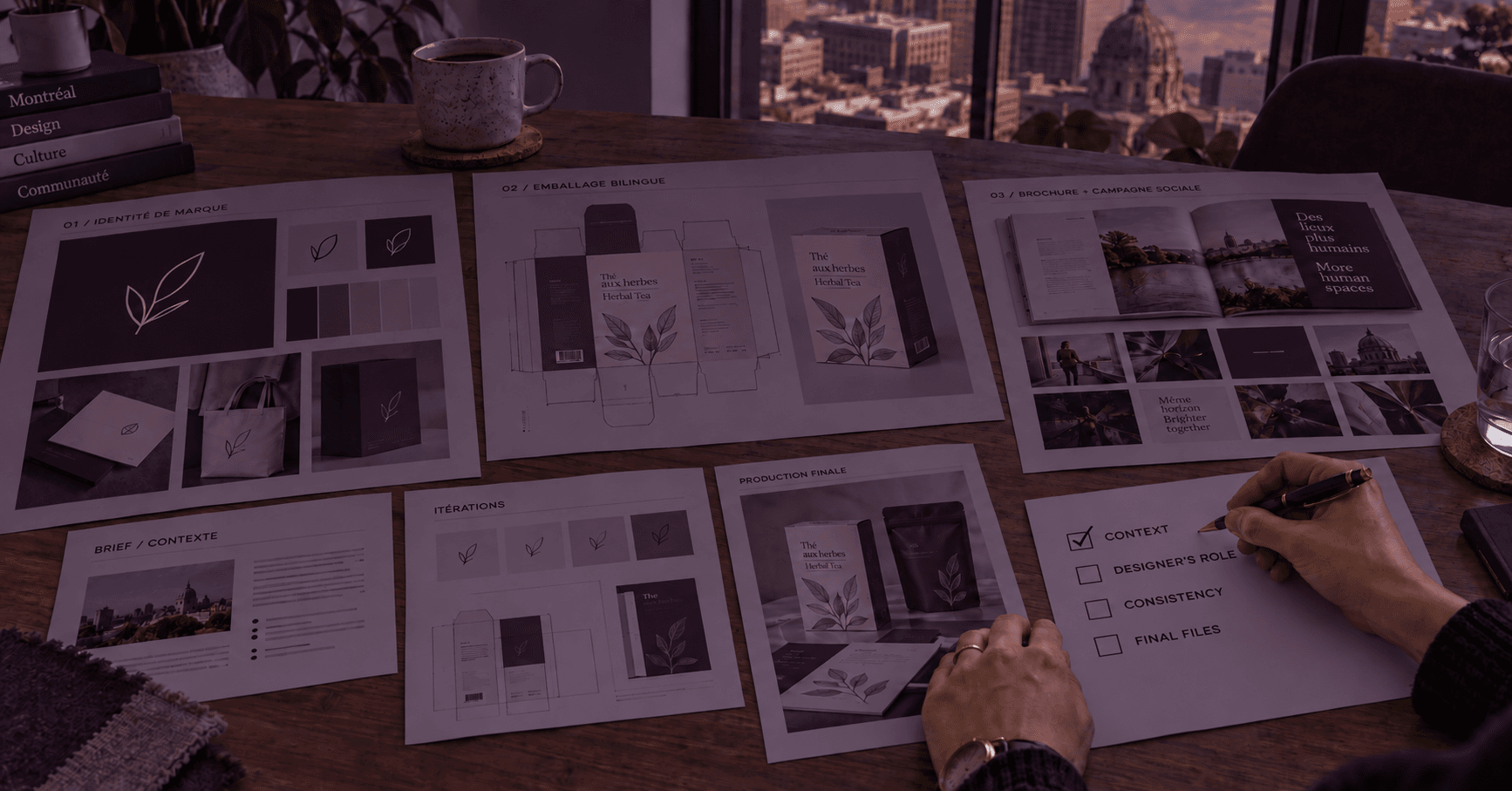

There is no single standard graphic design cost in Canada. A logo, brochure, packaging system and multi-channel campaign require very different amounts of strategy, production and creative work.
The price of a project normally depends on its scope, the number and type of deliverables, the level of creative development, the revision process, the deadline and the final files or usage rights required.
That means the most useful question is not simply, “What does graphic design cost?” It is:
What work is included, and does it solve the business problem I need to solve?
This guide explains how graphic designer pricing works, what published Canadian figures can—and cannot—tell you, and how to prepare a realistic budget before requesting a quote.
There is no single Canadian graphic design price
The Association of Registered Graphic Designers notes that comparing design prices can be difficult because designers offer different services and bring different levels of skill, experience and specialization.
A designer needs to understand the project before providing a reliable estimate. According to RGD’s guidance on what designers charge, relevant factors can include:
- The scope and number of deliverables
- The number of concepts and revision rounds
- Estimated project hours
- Urgency
- Anticipated expenses
- The volume of work
- The value and complexity of the project
A single social media graphic using an established brand system is not equivalent to developing a new visual identity. Similarly, designing one brochure is different from creating the brochure, preparing print-ready files and adapting the design for several digital channels.
The quote should reflect the actual work rather than rely on a universal price list.
What published Canadian data can and cannot tell you
Public wage and pricing information can provide context, but the figures are often misunderstood.
Employment wages are not freelance client rates
Canada’s Job Bank reports hourly employment wages for graphic designers and illustrators. Its current figures for Quebec are:
| Employment-wage context | Hourly amount |
|---|---|
| Low | $20.00 |
| Median | $30.00 |
| High | $51.28 |
These are employment wages based on labour-market data—not the amount a freelance client should expect to be billed. Canada Job Bank identifies them as wages for employed workers.
An independent designer’s project or hourly fee may also need to account for business expenses, software, equipment, insurance, administration, professional development, unpaid planning time and periods without billable client work.
For the same reason, RGD’s Creative Earners salary survey is useful for understanding employment and industry conditions, but it is not a freelance pricing sheet.
Published project estimates need context
Shopify Canada’s logo-cost guide provides broad logo-only estimates of $250–$2,500 for freelancers and $2,500–$10,000 for design firms. These numbers illustrate the wide range of possible approaches, from a basic logo assignment to a more extensive professional engagement.
However, Shopify’s figures are not a Canada-wide rate card, and they should not be applied automatically to brochures, packaging, social campaigns or complete brand systems. The guide itself explains that logo costs depend on factors such as complexity, designer expertise and the chosen service model.
A published range is therefore a starting reference—not a substitute for a project-specific quote.
What changes a graphic design quote?
Several practical decisions have a direct effect on the final project cost.
Scope and deliverables
The designer needs to know what must be created.
For example, “I need help with social media” could mean:
- One post
- A reusable post template
- Ten campaign graphics
- Multiple sizes for Instagram, LinkedIn and display advertising
- A complete visual system with templates and usage guidance
Each is a different project.
Strategy and creative development
Some projects begin with an existing brand, clear copy and prepared photographs. Others require research, visual direction, concept development or clarification of the brand’s message before design production can begin.
A project that includes strategic thinking will normally have a different scope from one that follows a complete, established system.
Concepts and revisions
The number of initial directions and included revision rounds should appear in the quote.
More concepts do not always create a better result. A focused process with a strong brief may be more useful than producing many unrelated options.
Revision scope matters as well. Adjusting a colour or typographic detail is different from changing the audience, campaign message or complete creative direction after approval.
Content and asset readiness
A project moves more efficiently when the client can provide approved copy, logos, brand files, product information and suitable photographs on time.
If content is incomplete, the designer may need to reorganize layouts, repeat production work or coordinate additional services. The quote should state who is responsible for supplying and approving content.
Timeline and urgency
A realistic schedule allows time for discovery, design, feedback and production. A compressed deadline may require the designer to reorganize other work or dedicate additional resources.
If the project has a fixed launch or print date, mention it before the quote is prepared.
Production and external expenses
Printing, licensed fonts, stock photography, illustration, copywriting, translation, photography, packaging prototypes and delivery are not always included in the design fee.
A quote should identify external costs or explain how they will be approved.
Final files, usage and ownership
Ask how final files, editable source files, usage rights, ownership and portfolio permission will be handled. The Canadian Intellectual Property Office notes that copyright ownership in commissioned work can depend on the agreement, so these terms should be clarified in writing. This is general information, not legal advice.
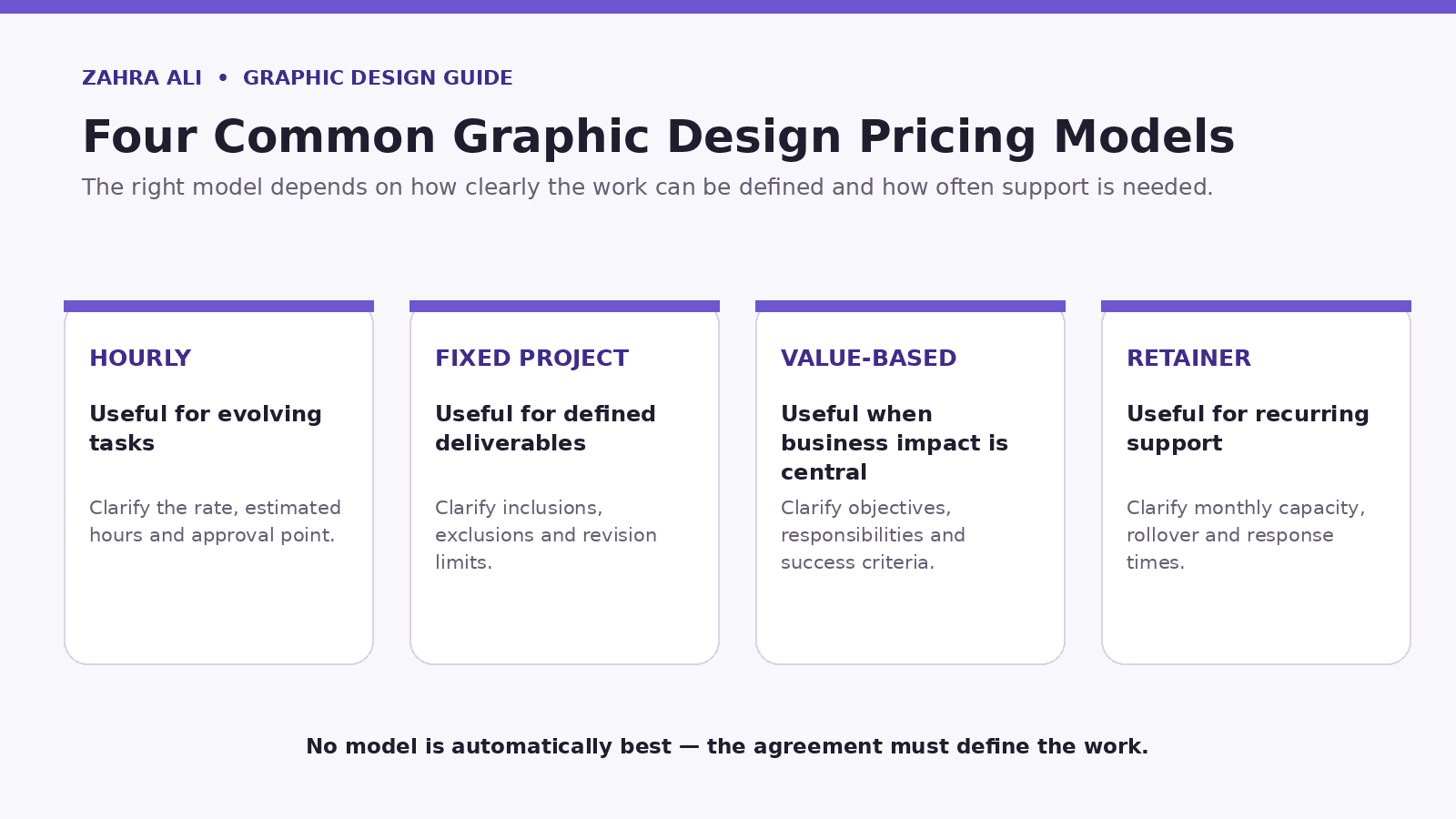
Hourly, fixed-project, value-based or retainer pricing?
A designer may use more than one pricing method, depending on the assignment.
| Pricing model | Often useful for | Main advantage | What to clarify |
|---|---|---|---|
| Hourly | Evolving support, production work or tasks with uncertain scope | You pay for the time used | Estimated hours, rate and approval point for additional time |
| Fixed project | Clearly defined deliverables and revision limits | Greater budget predictability | Exactly what is included and excluded |
| Value-based | Work closely connected to significant business value | Focuses on the importance of the result, not only hours | Scope, objectives, responsibilities and success criteria |
| Retainer | Recurring monthly design support | Reserved capacity and consistent collaboration | Monthly hours or deliverables, rollover rules and response times |
RGD’s pricing and payment resource explains that hourly, fixed, value-based and retainer models each suit different situations.
No model is automatically best. The important issue is whether the agreement clearly defines the work, payment schedule, revision limits and out-of-scope requests.
What should a professional graphic design quote include?
A useful quote should help both sides understand what will happen during the project.
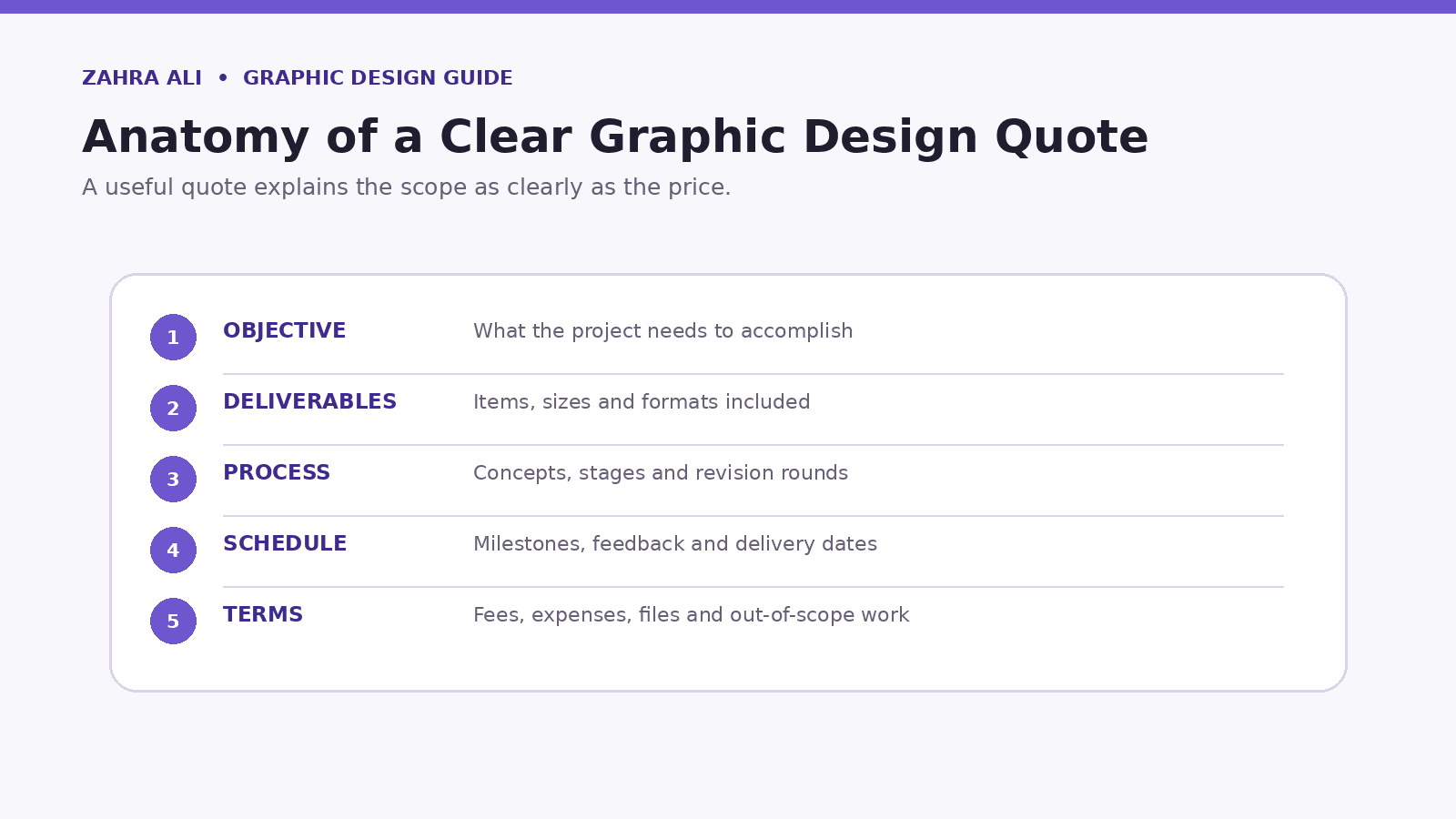
Look for:
- Project objectives
- Defined deliverables and sizes
- Number of concepts or creative directions
- Included revision rounds
- Project stages and estimated schedule
- Client content and approval responsibilities
- Design fees and payment schedule
- Estimated or excluded external expenses
- Final file formats
- Source-file and usage terms
- Treatment of additional or out-of-scope work
- Quote validity period
The lowest total is not necessarily the least expensive option if essential work is missing.
For example, one quote may include print preparation, multiple formats and two revision rounds. Another may cover only one design concept and a final PDF. Comparing the totals without comparing the scope would be misleading.
A practical graphic design scope ladder
It can help to think of scope in three levels.
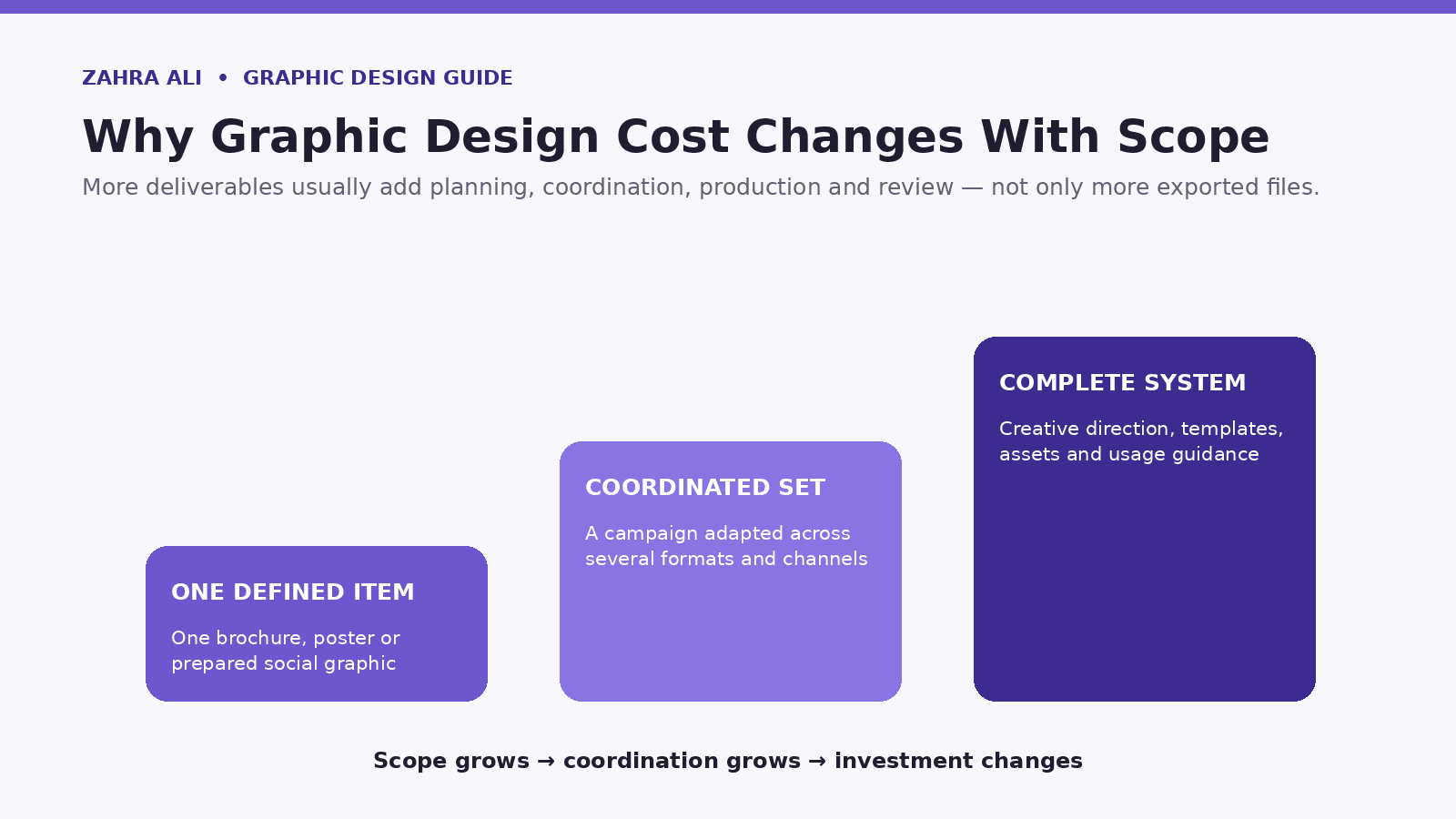
One defined item
Examples include one poster, one brochure or one social graphic with a prepared brief and existing brand assets.
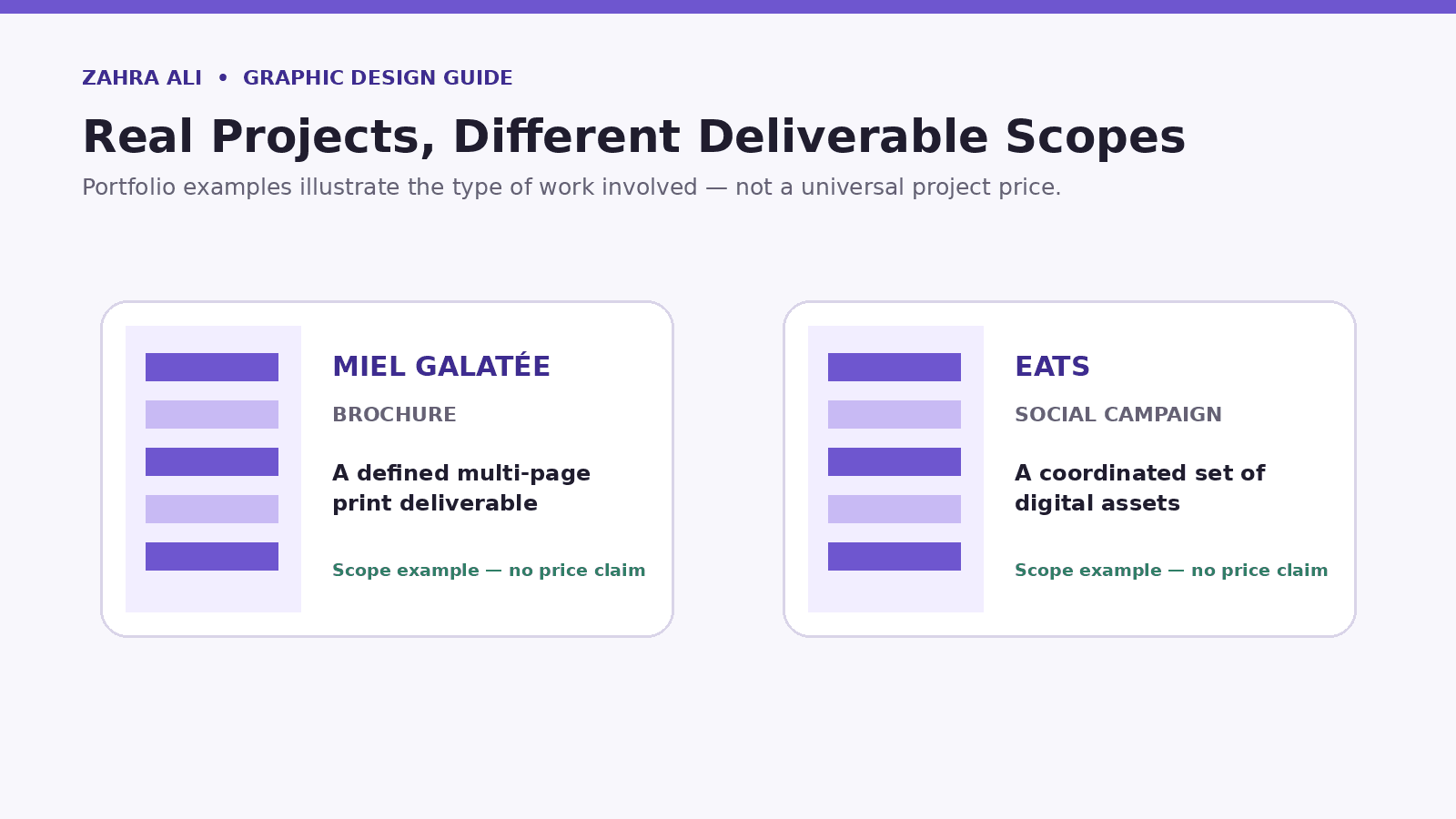
The Miel Galatée brochure project shows the context of a defined multi-page design deliverable. It should not be used to assume a price because the content volume, specifications and production requirements of every brochure differ.
A coordinated set
This could include several campaign assets adapted across print and digital channels.
An individual design may need multiple sizes, platform variations or layouts while maintaining one visual direction.
A complete system or campaign
A broader engagement may include creative direction, templates, a library of assets, usage rules and coordinated deliverables for several channels.
The Eats Instagram campaign illustrates a related set of social media deliverables. It is a scope example, not a claim about the client’s budget or campaign results.
Moving up the scope ladder usually adds planning, coordination, production and review—not simply more exported files.
Should you use DIY tools, AI, a freelancer or an agency?
The right choice depends on the risk, complexity and lifespan of the work.
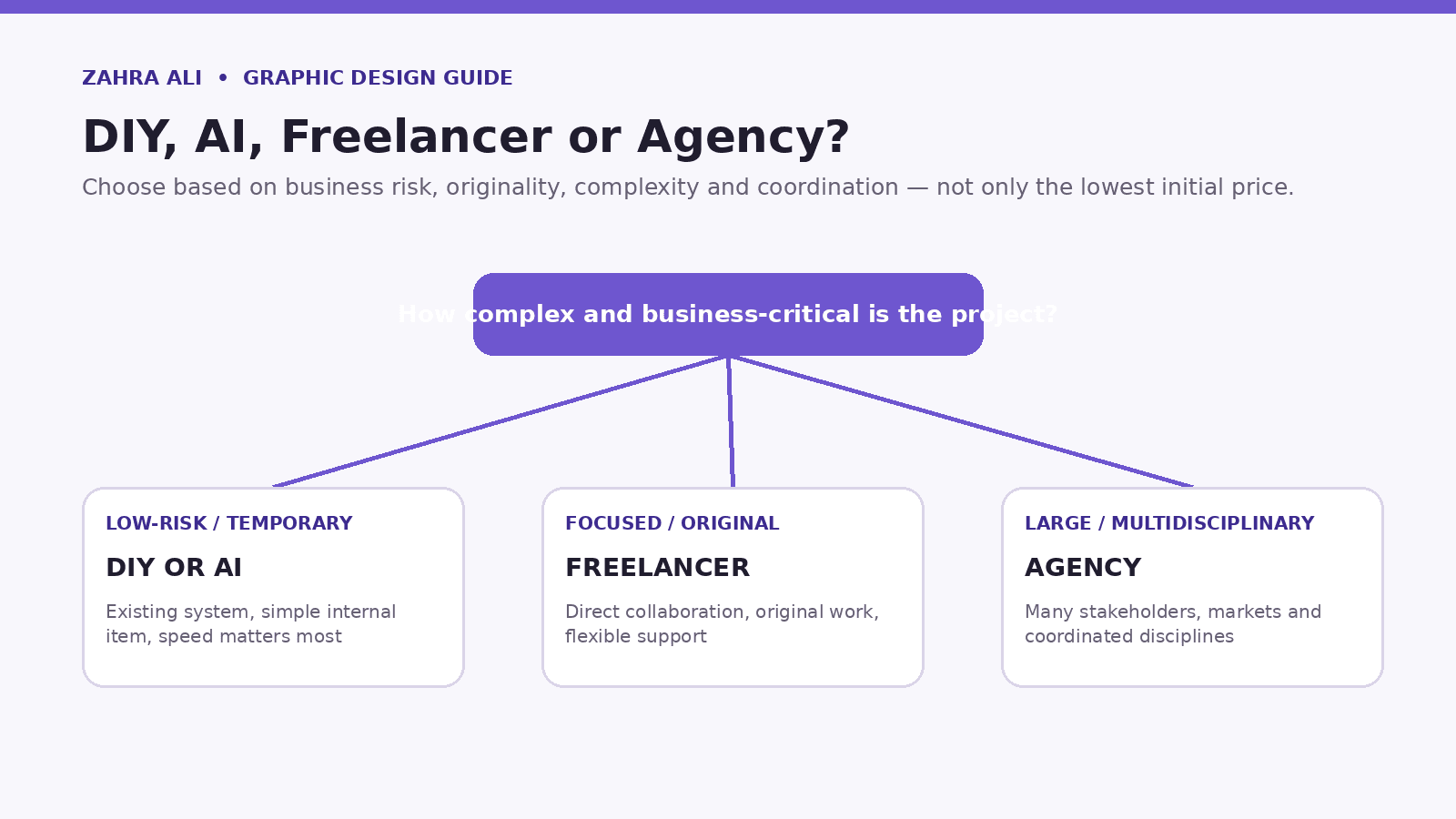
DIY or AI-assisted tools may fit when:
- The item is temporary or low risk
- You already have a strong brand system
- You need a simple internal graphic
- You can evaluate the design and licensing requirements yourself
- Originality is less important than speed
AI can help generate ideas or early variations, but the user still needs to check accuracy, consistency, rights, accessibility and suitability for the intended channel.
A freelance designer may fit when:
- You need original professional work
- The project has a clear decision-maker
- You want direct collaboration
- Your business needs a flexible level of support
- The scope can be handled by one specialist or a small group of collaborators
An agency may fit when:
- The project requires a larger multidisciplinary team
- Research, strategy, copy, design and production must run together
- Many stakeholders or markets are involved
- The rollout requires extensive account and project management
Choose based on the project’s needs rather than assuming the biggest provider is always the best option.
How to prepare a realistic graphic design budget
You do not need to solve every design decision before contacting a professional. A designer can help determine the right formats, production method and deliverables.
Before requesting a quote, prepare:
- The business goal: Explain what needs to change or what the project must help you accomplish.
- The audience: Identify who should notice, understand or act on the design.
- Must-have deliverables: Separate essential items from possible additions.
- Channels and specifications: Note where the work will appear, even if you do not know every technical size.
- Available content and brand assets: Gather logos, fonts, colours, copy, photographs and existing guidelines.
- The deadline: Include launch, event, advertising or print-production dates.
- A workable budget range: A range helps the designer recommend a suitable scope. It does not require you to know the “correct” price in advance.
- The decision-maker: Decide who will consolidate feedback and approve the work.
If you are unsure what to request, my graphic design services in Montreal and worldwide can include guidance on defining the appropriate deliverables before the project scope is finalized.
You can also use my guide to preparing a graphic design project brief before your first call with a designer.
Download the Graphic Design Budget & Scope Planner
Use this planning worksheet to organize your goals, deliverables, timeline, budget range, feedback process and final-file needs before requesting quotes. This is a planning worksheet, not a quote or contract.
When a lower quote is not actually cheaper
A quote may appear inexpensive because important items are excluded.
Before choosing, check whether you may later need to pay separately for:
- Additional revision rounds
- Resizing for other channels
- Print-ready production files
- Editable source files
- Font, image or illustration licences
- Content changes after layout approval
- Additional concepts
- Rush work
- Project management
- Future template versions
Also consider communication and process. Unclear responsibilities or scattered feedback can create delays and repeated work even when the original fee is low.
The best value is usually the quote that clearly matches the project—not necessarily the one with the smallest number at the bottom.
Get a quote based on a real scope
A useful graphic design estimate begins with the business goal, required deliverables, timeline and available content.
You do not need to arrive with every technical answer. Bring what you know, identify what remains uncertain and ask the designer to explain the recommended scope.
If you are planning a branding, campaign, brochure, packaging or digital design project, tell me what you are preparing. I can help clarify the deliverables before providing a project-specific quote.