

The first sign of AI disruption may not be a wave of layoffs. It may be the job opening that never appears, the junior role that is never approved, or the routine assignment that disappears from a worker’s day.
That warning is already visible in Canadian data. A 2026 Bank of Canada analysis estimated that the job-finding-rate gap between occupations with full AI exposure and those with none was -13.9 percentage points in 2025, compared with -2.2 points in 2015–2019. This is an estimated difference between theoretical exposure extremes—not a literal comparison of two groups of workers—and the Bank does not claim that AI alone caused it. Still, the direction is hard to ignore: pressure may be arriving through weaker hiring before it appears as mass job losses. Bank of Canada, August 2026
The honest answer to which jobs are most at risk from AI in Canada is therefore more complicated than a viral list of doomed careers. Canada is not seeing widespread occupational disappearance. It is seeing rapid task automation, changing hiring needs, pressure on routine information work and a possible weakening of some entry-level pathways.
Waiting for an occupation to vanish before adapting would be a serious mistake.
The warning is not mass layoffs. It is fewer doors opening.
Five Canadian findings matter most:
- The Bank of Canada’s average AI-exposure score for Canadian occupations was 0.29 in 2025, suggesting that close to one-third of jobs could undergo substantial task change with current AI capabilities. Its highest-exposure list includes data entry clerks, receptionists, travel agents, payroll and accounting clerks, financial clerks, customer service representatives and office support workers. Exposure means tasks can change; it does not prove the occupation will disappear. Bank of Canada
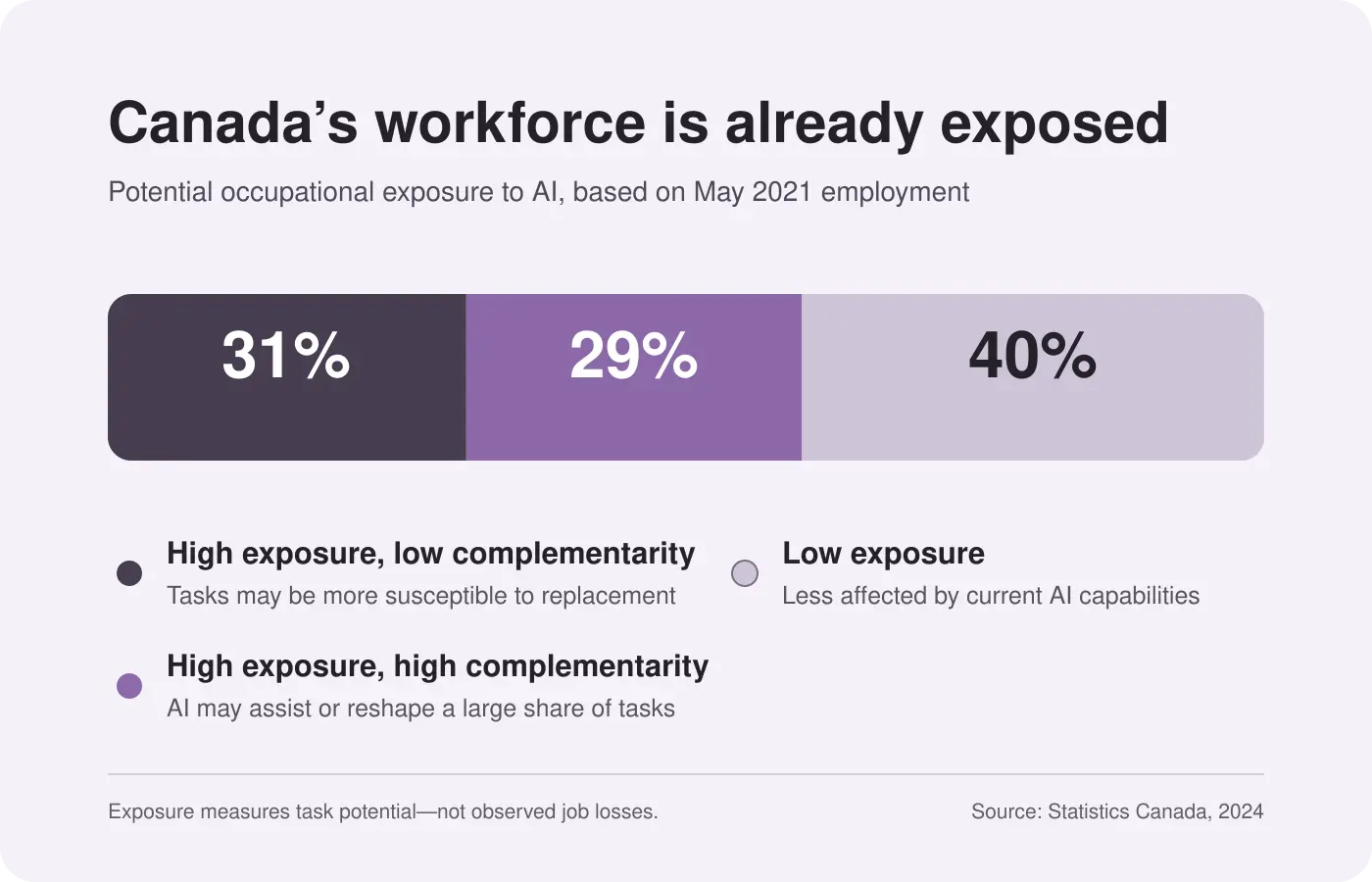
- Statistics Canada’s experimental classification, based on May 2021 employment, placed 31% of Canadian workers in high-exposure, low-complementarity occupations, 29% in high-exposure, high-complementarity occupations, and 40% in low-exposure occupations. High exposure can mean competition from AI or productive assistance from it, depending on the work. Statistics Canada, September 2024
- AI use by Canadian businesses doubled from 6.1% in the second quarter of 2024 to 12.2% in the second quarter of 2025. Among AI-using businesses in 2025, 89.4% reported no employment change, 6.3% reported a decrease and 4.3% reported an increase. But 84.9% said AI had reduced tasks previously performed by employees to at least some extent: 47.2% to a small extent, 32.4% to a moderate extent and 5.3% to a large extent. Headcount can look stable while the work underneath it is being compressed. Statistics Canada, June 2025
- By March 2026, 35.9% of Canadian workers aged 15 to 69 reported using generative AI at work during the previous 12 months. Usage was 53.8% in high-exposure/high-complementarity occupations and 45.9% in high-exposure/low-complementarity occupations, compared with 14.2% in low-exposure work. The transition is no longer hypothetical or limited to a small group of early adopters. Statistics Canada, July 2026
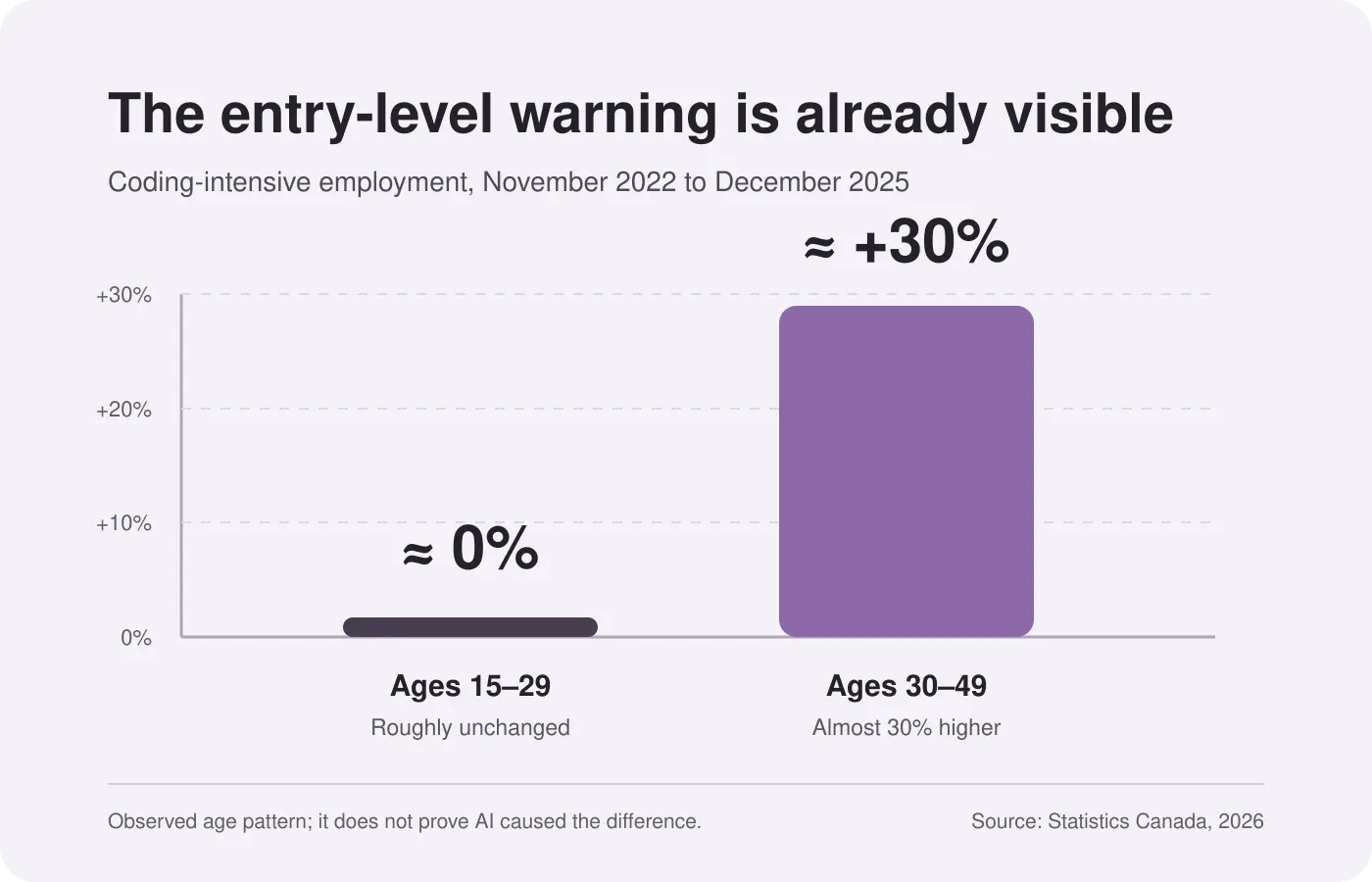
- From November 2022 to December 2025, employment did not show a clear, persistent collapse in Canada’s high-exposure, low-complementarity occupations. But in coding-intensive jobs, employment among workers aged 15 to 29 was roughly flat while employment among workers aged 30 to 49 was almost 30% higher. That divergence does not prove AI causation, but it is a serious signal about the entry-level ladder. Statistics Canada, January 2026
These findings do not support panic. They do support urgency.
What “at risk from AI” actually means
The language matters because six different outcomes are often collapsed into the word “replacement.”
| Term | What it means | What it does not prove |
|---|---|---|
| AI exposure | A significant share of an occupation’s tasks could be affected by current AI capabilities. | That jobs have already been lost. |
| Task automation | A system performs a specific task with less human effort. | That it can perform the entire role safely or well. |
| AI complementarity | AI helps a worker perform tasks faster or with more information. | That employment will automatically grow. |
| Hiring pressure | Employers reduce, delay or redesign openings. | That current employees are being laid off. |
| Employment contraction | The number of people employed in an occupation declines. | That AI is the only cause. |
| Occupational disappearance | An occupation largely ceases to exist. | A conclusion supported by current Canadian AI data. |
The Bank of Canada and Statistics Canada use different exposure methods. Their percentages should not be treated as interchangeable scores. Both point to the same broader lesson, however: AI affects tasks unevenly, and the ability to automate a task is not the same as the ability to remove a job.
Generative AI is only one part of the disruption
Generative AI produces text, images, code, summaries and analysis. Older automation includes self-service systems, robotic process automation, industrial machinery, scheduling software and rules-based workflows.
This distinction matters. A reduction in cashiers, manufacturing workers or clerical staff may reflect years of self-service technology, process automation, offshoring, economic conditions or organizational redesign—not simply the arrival of a chatbot. Statistics Canada also found that vacancies in both high-exposure, low-complementarity occupations and low-exposure occupations fell by almost half from the fourth quarter of 2022 to the third quarter of 2025. A weak labour market can hit very different occupations at once. Statistics Canada

The occupation groups under the greatest pressure
The most exposed jobs share a pattern: a large part of the work is routine, codifiable, digital and based on moving or transforming information. The role may remain, but fewer people may be needed to perform the same volume of routine work.
1. Data entry, records and routine office support
Why the work is exposed: These roles often involve copying information between systems, classifying records, updating fields, checking standard forms and producing repeatable documents.
Tasks most likely to shrink or change: Manual data entry, basic document sorting, transcription, standard record retrieval and repetitive formatting.
Responsibilities likely to remain: Resolving exceptions, validating sensitive information, correcting system errors, applying privacy rules and coordinating with people when records are incomplete or ambiguous.
What the Canadian evidence shows: The Bank of Canada lists data entry clerks, records management technicians and office support workers among the occupations most exposed to current AI capabilities. Canada’s 2024–2033 occupational projections also place data entry clerks among the relatively small group of occupations at moderate or strong risk of labour surplus. That projection is not an AI-causation finding, but the overlap with highly automatable tasks strengthens the warning. Canadian Occupational Projection System
2. Reception, scheduling and travel booking
Why the work is exposed: Booking, rescheduling, answering standard questions and routing requests can be handled through conversational systems connected to calendars and databases.
Tasks most likely to shrink or change: First-line inquiries, routine confirmations, appointment reminders, itinerary comparison and standard reservation changes.
Responsibilities likely to remain: Handling distressed or complex customers, resolving disruptions, exercising judgment, managing accessibility needs and protecting personal information.
What the Canadian evidence shows: Receptionists and travel agents appear on the Bank of Canada’s highest-exposure list. The immediate risk is not that every front desk disappears. It is that one worker with better systems may handle a workload that previously required several people.
3. Payroll, bookkeeping and financial clerical work
Why the work is exposed: Much of the workflow follows structured rules and standardized data: reconciliation, classification, routine calculations, form preparation and anomaly detection.
Tasks most likely to shrink or change: Transaction coding, basic reconciliation, repetitive payroll adjustments, standard reports and first-pass document review.
Responsibilities likely to remain: Interpreting unusual cases, controlling access, explaining results, resolving disputes, complying with regulation and accepting professional accountability.
What the Canadian evidence shows: Payroll administrators, accounting clerks and other financial clerks are among the Bank of Canada’s most exposed occupations. Statistics Canada’s high-exposure, low-complementarity examples also include accounting. This points to a smaller routine workload—not the end of financial judgment or accountable professional practice.
4. Basic customer service and sales support
Why the work is exposed: AI can search knowledge bases, draft replies, summarize conversations and resolve predictable questions at scale.
Tasks most likely to shrink or change: Password resets, order-status questions, standard returns, scripted product answers, call summaries and simple lead qualification.
Responsibilities likely to remain: De-escalation, unusual complaints, vulnerable customers, negotiation, relationship management and cases with financial, legal or safety consequences.
What the Canadian evidence shows: Customer service representatives are on the Bank’s high-exposure list, while federal projections say clerical work and some basic customer-service work are highly susceptible to automation. The danger is concentrated in scripted, high-volume service—not every human interaction.
5. Standardized information and quality-control roles
Some quality-control and information-management jobs depend on classifying known patterns against clear standards. AI can accelerate that first pass.
The Bank of Canada lists food and beverage quality controllers and health information management workers among highly exposed occupations. But automated flagging is not the same as final accountability. Physical inspection, regulatory documentation, investigation and exception handling can keep people firmly inside the process.
Professional roles are more likely to be transformed than erased
AI is not limited to low-skill work. It can reach highly educated occupations because those jobs also contain research, drafting, classification, coding and analysis. The more consequential the work, however, the more human judgment and accountability matter.
Software development, testing and technical support
AI can produce boilerplate code, suggest fixes, generate tests, summarize documentation and answer routine support questions. That can raise the output expected from each developer—and reduce the amount of beginner work available.
Statistics Canada’s early evidence is sobering for newcomers: by December 2025, employment in coding-intensive jobs among workers aged 15 to 29 was about where it had been in November 2022, while employment among workers aged 30 to 49 was almost 30% higher. This pattern could reflect employers favouring experienced workers who can supervise AI-assisted output, but the study does not establish AI as the cause.
The lesson is not “do not learn to code.” It is “syntax alone is no longer enough.” System understanding, security, testing, architecture, communication and verification carry more weight when code generation becomes cheap.
Marketing, routine content and graphic production
Generative systems can resize assets, remove backgrounds, draft variations, summarize briefs and create large volumes of generic content. That puts production-only work under pressure.
Brand judgment, art direction, original strategy, accessibility, production knowledge and the ability to connect design to business results remain harder to automate responsibly. Canada’s occupational projections identify graphic designers and illustrators as one occupation facing surplus risk through 2033, but the projection does not say AI caused that risk. Competition, labour supply, industry conditions and changing production models also matter.
For a closer look at the creative market, read Montreal’s graphic design job-market analysis. Businesses that need accountable brand and production work can also review graphic design services and selected portfolio projects.
UX/UI and product design
AI can generate interface options, summarize research notes and accelerate prototypes. It cannot safely decide which problem a business should solve, whether research is valid, whether an interaction excludes users, or which trade-off is acceptable.
The vulnerable part of UX/UI is mechanical production without strong research, product thinking or implementation awareness. The defensible part is the ability to frame problems, understand behaviour, test assumptions, design accessible systems and take responsibility for outcomes.
This article deliberately keeps the UX/UI forecast brief. Read the dedicated analysis, Will AI Replace UX Designers in Canada?, or explore UX/UI design services for the practical business application.
HR, recruiting, legal and policy support
AI can screen structured information, summarize documents, prepare first drafts and retrieve standard policies. Those capabilities can reduce support work while making review more important.
Hiring decisions, legal interpretation, employee relations, negotiation, ethics and public accountability cannot be treated as consequence-free text generation. In these fields, speed without verification creates risk rather than value.
The entry-level ladder may take the first hit
The most dangerous transition is not necessarily the disappearance of a profession. It is the removal of the junior tasks through which people learn it.
If AI drafts the first report, creates the first interface variation, writes the simple code and answers the standard support ticket, employers may conclude they need fewer beginners. That can produce a paradox: companies want experienced workers, but stop creating the work that builds experience.
The Canadian coding data is an early warning, not a final verdict. Young workers’ coding-intensive employment stagnated while the 30-to-49 group grew strongly. The Bank of Canada also notes that young workers are more concentrated in several moderately or highly exposed occupations, including customer service and sales support.
Workers should respond by building proof of judgment, not just tool familiarity. Employers should respond by redesigning entry-level roles—not eliminating their future talent pipeline.
Lower-exposure work is not invulnerable
The Bank of Canada’s lowest-exposure examples include nursing professionals, teachers, carpenters, electricians, dentists, physiotherapists, massage therapists and roofers. These jobs rely heavily on physical work, trust, regulated judgment, unpredictable environments or direct human care.
That does not make them technology-proof. Scheduling, documentation, diagnostics, training and administration can still change. Robotics and older forms of automation may also reach physical tasks that generative AI does not.
But the national outlook is not a story of universal job destruction. Canada’s 2024–2033 projections place 103 of 516 occupations at moderate or strong risk of shortage, compared with only 17 at moderate or strong risk of surplus. Health occupations account for 34 shortage-risk occupations, while construction trades and transportation account for another 28. Canadian Occupational Projection System
The economy will still need people. The mix of tasks, skills and entry routes is what changes.
New opportunities will grow—but transition is not automatic
Canada’s occupational projections estimate 8.1 million job openings from 2024 to 2033. About 2.6 million are expected from economic growth and more than 5.5 million from replacement needs, mainly retirements. Those openings are not all AI jobs, and they will not automatically absorb every displaced worker.
The strongest emerging areas around AI are better understood as capability groups than as a list of fashionable job titles:
- AI implementation and integration: connecting tools to real workflows, data and business systems.
- Governance, privacy, safety and compliance: setting rules, documenting decisions and managing risk.
- Cybersecurity: protecting AI-enabled systems, identities, models and data. COPS includes cybersecurity specialists among occupations facing shortage risk through 2033.
- Data engineering and infrastructure: preparing reliable data, pipelines, cloud systems and monitoring.
- Model evaluation and quality assurance: testing accuracy, bias, failure cases and real-world performance.
- AI product and UX design: making automated systems understandable, accessible and controllable by people.
- Training and change management: helping teams redesign work, learn safe practices and measure results.
Canada’s 2026 national AI strategy sets targets of up to 250,000 jobs created through AI adoption and 90,000 AI-related jobs or work placements for young Canadians by 2031. These are policy targets, not independent labour-market forecasts or guarantees. They show where government intends to push investment; they do not prove that transition will be smooth. Innovation, Science and Economic Development Canada
The uncomfortable truth is that new opportunities may require different skills, appear in different regions or industries, and arrive later than the jobs being squeezed.

What Canadian workers should do now
Do not wait for a formal announcement that your occupation is “replaced.” Audit the work you already do.
- List the routine tasks. Identify anything repetitive, rules-based, digital and easy to check. Assume those tasks will become faster and cheaper.
- Find the decisions hidden around them. Exceptions, trade-offs, client conversations, risk and accountability are where human value often remains.
- Learn to supervise AI output. Prompting is not enough. Verify facts, test edge cases, document sources and recognize when the system should not be used.
- Strengthen domain knowledge. A generic AI user is easy to replace. A person who understands the field, the customer and the consequences is harder to remove.
- Build evidence of outcomes. Show how your work improved revenue, usability, accuracy, accessibility, speed or risk—not merely which tools you used.
- Protect quality, privacy and security. Employers need people who can identify the failures that automated output hides.
- Develop human leverage. Communication, facilitation, negotiation, research and accountability become more valuable when routine production is abundant.
The goal is not to compete with a machine at producing more drafts. It is to become the person who knows which draft is right, what is missing and what happens if the decision fails.
What businesses should do before automating a role
Replacing a task is not the same as removing a role. Businesses that ignore that distinction risk faster errors, damaged customer trust, privacy failures and a workforce with no path to develop expertise.
Before reducing headcount, employers should:
- map the role task by task;
- identify which decisions carry legal, financial, accessibility or safety consequences;
- test accuracy on real cases, including unusual ones;
- define who reviews output and who remains accountable;
- measure customer experience and error rates, not only time saved;
- retrain employees whose routine work is reduced;
- preserve entry-level learning paths;
- tell workers how the technology will be used and how their performance will be assessed.
Statistics Canada’s business survey shows why this approach is more realistic than a replacement fantasy. Among AI-using businesses, 40.1% had developed new workflows, 38.9% had trained current staff and 18.2% had used vendors or consultants to install or integrate AI. Only 6.3% reported an employment decrease attributed to AI use. Statistics Canada
The immediate management challenge is redesigning work responsibly.
What this means for creative and digital services
AI can accelerate wireframes, content drafts, image variations, audits and technical production. It cannot take responsibility for whether a brand is credible, a user journey works, a website is accessible, or a digital investment serves the business.
That is where multidisciplinary work becomes more valuable. Strategy, UX/UI, graphic design, website implementation and SEO need to operate as one accountable system—not as disconnected AI outputs.
If your organization is redesigning a product, brand or digital workflow, review Zahra Ali’s UX/UI services, graphic design services and portfolio. To discuss a project, contact Zahra.
The decision workers and businesses cannot postpone
No credible Canadian source can name the date when a whole profession will disappear. That uncertainty is not permission to ignore the transition.
The pressure is already measurable: AI adoption doubled in one year, more than one-third of workers reported using generative AI at work by March 2026, highly exposed occupations show a much weaker job-finding signal, and young workers have not shared equally in recent coding-job growth. At the same time, most AI-using businesses have not cut employment, and Canada’s labour market is projected to generate millions of openings through 2033.
Both realities are true. Jobs are not vanishing all at once. The value of routine work is being compressed now.
The people and organizations most likely to succeed will be those that redesign work before the market forces them to.
Frequently asked questions
Which jobs are most likely to be replaced by AI in Canada?
Current Canadian evidence does not confirm the complete replacement of a major occupation. The highest pressure is on routine, codifiable information tasks found in data entry, records work, office support, reception, travel booking, payroll and accounting clerical work, financial clerical work and basic customer service. Some roles may contract, while others will retain people for exceptions, judgment, relationships and accountability.
Is AI already causing layoffs in Canada?
The evidence is mixed. Statistics Canada found that 89.4% of AI-using businesses reported no employment change in the second quarter of 2025, while 6.3% reported a decrease. The Bank of Canada found a worsening job-finding signal in highly exposed occupations but almost no change in the relative job-separation rate. That points more clearly to possible hiring pressure than to a proven national wave of AI layoffs.
Will AI replace UX/UI designers or graphic designers?
AI is already automating parts of production, including interface variations, image generation, resizing, summaries and first drafts. Roles built only around routine production face greater pressure. Research, product judgment, accessibility, brand strategy, art direction and accountable implementation remain more defensible. See the dedicated Canadian UX/UI forecast and Montreal graphic-design market analysis for more detail.
Are skilled trades and health-care jobs safe from AI?
They are generally less exposed to current generative AI because they depend on physical work, direct care, unpredictable environments and regulated judgment. They will still use more AI in documentation, diagnostics, scheduling and training, and some tasks may be affected by robotics or older automation. Lower exposure does not mean zero change.
What skills are safest to build?
No skill is permanently safe, but domain expertise, critical evaluation, communication, research, accessibility, security, privacy, systems thinking and accountability are difficult to reduce to generic automated output. The strongest position combines AI fluency with the ability to verify work and make responsible decisions.
Make AI improve the work—not damage the experience
Adopting AI without clear UX, responsible workflows and strong visual communication can make a business faster at producing the wrong result. Zahra combines UX/UI, graphic design, website implementation and SEO to create digital work that remains useful, credible and accountable.