

A customer may discover a business in a TikTok video, check its reviews on Google Maps, ask ChatGPT to compare it with alternatives, and finally book or buy on the company’s website.
That is the major change in 2026: discovery is no longer one search followed by one click. It is a journey across search engines, social platforms, maps, AI answers and the business’s own website.
The practical answer is not to abandon SEO or chase every new “AI optimization” tactic. Build one accurate, useful and trustworthy business presence that every channel can understand.
Where customers discover businesses today
| Discovery channel | What customers do there | What businesses should prioritize | Best for |
|---|---|---|---|
| Google Search and AI Mode | Research problems, services and options | Crawlable expert content, clear service pages and strong SEO fundamentals | High-intent research |
| TikTok, Instagram and YouTube | Discover visually, learn and validate style or expertise | Useful demonstrations, clear captions, searchable titles and consistent profiles | Inspiration and awareness |
| ChatGPT and other AI answers | Ask for shortlists, comparisons and recommendations | Accurate public pages, clear facts and access for relevant search crawlers | Conversational research |
| Google Maps and reviews | Verify local options, reputation, hours and location | A complete Business Profile, current details, photos and genuine reviews | Local decisions |
| AI shopping and browser agents | Compare products, check availability or complete tasks | Structured product data, accessible forms, clear policies and stable interfaces | Shopping, booking and action |
| Your website | Confirm trust and convert | Fast mobile experience, proof, clear offers and an obvious next step | Final decision and conversion |
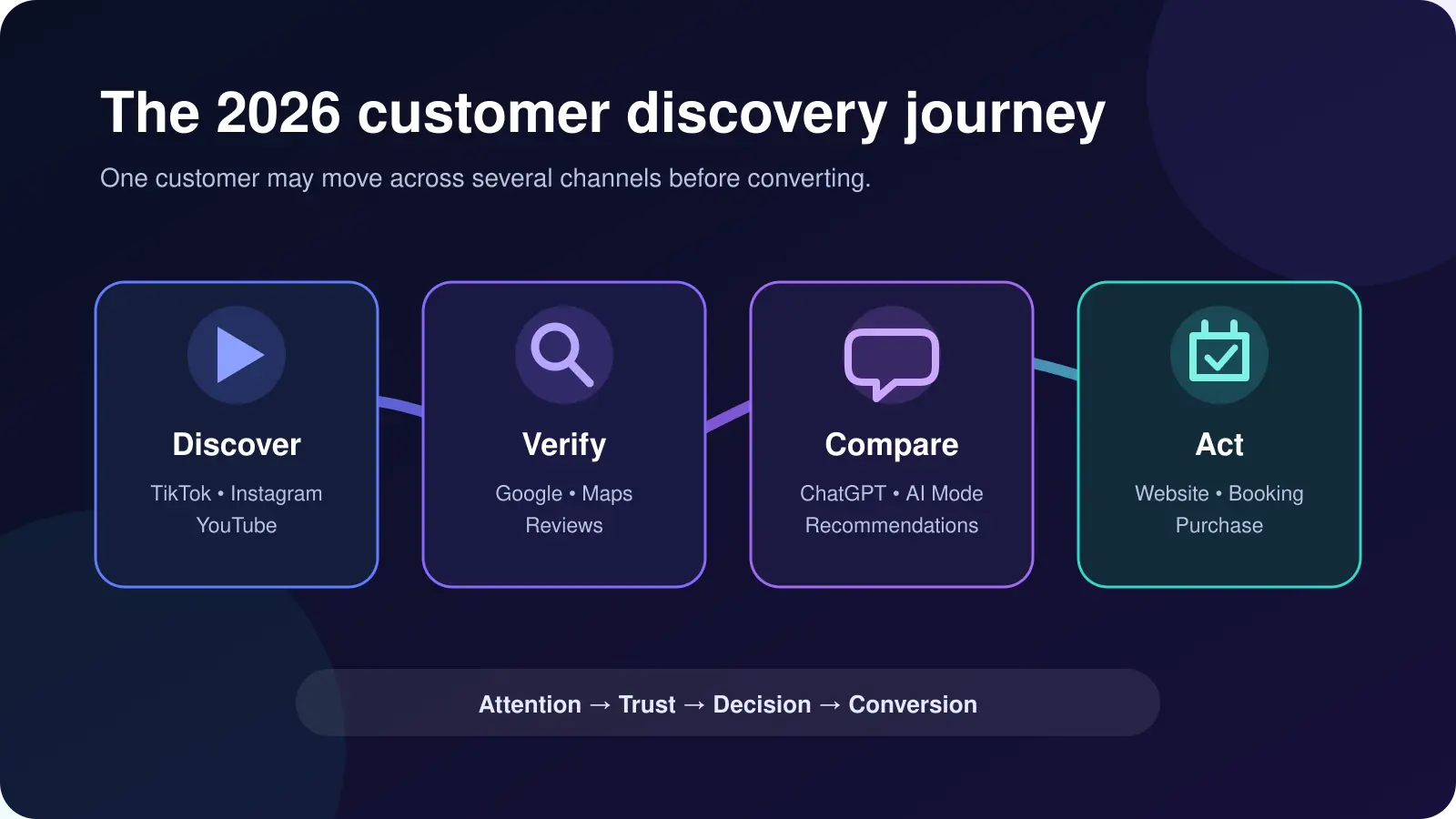
Discovery is layered—not replaced
Google still matters. Social media has not replaced search, and ChatGPT has not replaced either of them. Each channel now plays a different role.
Someone may see a restaurant on TikTok, check its rating and opening hours in Maps, ask an AI assistant whether it suits a family dinner, and then use the website to reserve a table. A potential client may find a designer through Google, inspect work on Instagram, compare several providers with ChatGPT, and return to the portfolio before making contact.
This means businesses should stop treating SEO, social media, reviews and website UX as isolated projects. They are connected parts of one buying decision.
1. Google now combines traditional search with AI answers
Google’s AI Overviews and AI Mode can answer complex questions, explore related searches and link to supporting websites. However, Google’s current guidance is clear: the usual SEO foundations still apply, and there is no special requirement for appearing in these AI experiences.
What matters most:
- Publish original information based on real expertise, experience or evidence.
- Make important pages crawlable and indexable.
- Use clear titles, headings and page structure.
- Add useful images and video when they help the reader.
- Maintain accurate local and product information.
- Provide a fast, usable experience after the click.
Google specifically recommends valuable, non-commodity content instead of generic pages that simply repeat what is already online. It also confirms that Google Business Profiles and Merchant Center data can support visibility for local businesses and products in both traditional and AI-powered results.
Official Google guidance for generative AI search
2. Social platforms are search and discovery engines
Social discovery is strongest when people want to see the answer: how a product works, what a place looks like, whether a professional appears credible, or what result a service can produce.
TikTok now connects videos, search and location pages with business discovery and, in some markets, booking experiences. YouTube’s discovery system matches viewers with videos they are likely to watch and enjoy. Public photos and videos from eligible professional Instagram accounts may also be indexed by external search engines.
For a small business, this does not mean posting constantly. It means creating a smaller number of useful, searchable pieces of content:
- Demonstrate the service instead of only describing it.
- Answer one real customer question per video.
- Use a clear spoken topic, on-screen title and caption.
- Mention the business type and location naturally when relevant.
- Keep the business name, website and service details consistent across profiles.
- Show real work, products, places, processes and results.
A visually strong post may create the first impression, but customers will often verify the claim elsewhere before acting.
TikTok GO: discovery through video, search and location pages
YouTube search and discovery guidance
Instagram’s search-engine indexing explanation
3. ChatGPT is becoming a comparison and product-discovery layer
Instead of searching with two or three keywords, people can describe a complete need:
“Compare three website designers in Montreal for a small service business. I need WordPress experience, strong UX/UI work and a budget-conscious approach.”
ChatGPT can search public sources, summarize options and link to websites. OpenAI says any public website may appear in ChatGPT search, but publishers should avoid blocking OAI-SearchBot if they want their content included in summaries and citations. Referral links from ChatGPT search include utm_source=chatgpt.com, which makes this traffic measurable in analytics.
For product businesses, discovery is becoming more structured. ChatGPT can use product data such as descriptions, images, prices and availability. Shopify catalogs are already integrated, while eligible merchants can apply to provide direct feeds for more control and freshness.
What businesses should do:
- Keep service, product, location, pricing and policy information accurate.
- Create pages that clearly explain who the offer is for and what makes it different.
- Make evidence easy to verify: portfolios, case studies, reviews and original examples.
- Check that the site is not unintentionally blocking relevant search crawlers.
- For ecommerce, maintain accurate structured product data and availability.
Being crawlable does not guarantee a recommendation. It only makes the information available for consideration; relevance, evidence and the user’s request still matter.
OpenAI’s publisher guidance for ChatGPT search
How product discovery works in ChatGPT
4. Maps and reviews remain decisive for local businesses
AI may suggest a business, but local customers still want proof that it is real, nearby, open and trusted.
Google says local results are mainly influenced by relevance, distance and prominence. Complete business information helps Google understand relevance, while reviews and links contribute to prominence.
Keep these elements current:
- Correct primary category and services
- Address or service area
- Regular and special hours
- Phone number and website
- Recent, accurate photos
- Genuine customer reviews
- Helpful, professional review responses
Do not create fake reviews or manufacture mentions. They create reputational risk and do not build the reliable evidence that customers need.
Google Business Profile local-ranking guidance
5. AI agents will move from finding information to taking action
Search tools answer questions. Agents can go further: compare specifications, inspect availability, fill a form, start a booking or move through a purchase flow on the user’s behalf.
This is still an emerging area, but the preparation is practical. Agents may interpret screenshots, HTML and the accessibility tree. Sites become easier for both humans and agents when they use:
- Real links and buttons instead of clickable generic containers
- Proper labels connected to form fields
- Clear product, service and policy information
- Stable layouts without hidden overlays
- Accessible names, roles and states
- Obvious confirmation before a purchase or sensitive submission
This is not a new ranking trick. It is good UX, semantic development and accessibility applied to a new type of website visitor.
Google Chrome team: building agent-friendly websites
What not to waste time on
| Hype | Practical reality |
|---|---|
| “SEO is dead” | Google says established SEO practices remain the foundation of its AI search features. |
| “Create hundreds of AI-written pages” | Scaled content without added value may violate Google’s spam policies and gives readers little reason to trust the site. |
“Add llms.txt and Google AI visibility will improve” | Google states that it ignores llms.txt; the file neither improves nor harms Google rankings. Other services may develop their own uses. |
| “Write separate versions for search engines and AI” | Publish one strong, human-first source with clear structure and verifiable information. |
| “Buy mentions and reviews” | Inauthentic signals create risk and do not replace real authority or customer evidence. |
A practical 2026 visibility plan
1. Make your business identity consistent
Use the same name, service description, website, location and contact information across your site, Google Business Profile and social accounts.
2. Publish proof that cannot be copied easily
Use original case studies, before-and-after examples, portfolio work, demonstrations, customer questions and first-hand lessons.
3. Create content for discovery and content for decisions
Short videos and visual posts can create interest. Detailed service pages, guides, comparisons and case studies help people evaluate and act.
4. Keep Google and ChatGPT access intentional
Check indexing, robots rules and important page visibility. Allow the crawlers you want to serve; block training or search crawlers only when that choice matches your policy.
5. Strengthen local or product data
Maintain the Google Business Profile for local services. For ecommerce, keep product titles, descriptions, images, prices, availability and identifiers accurate in supported feeds.
6. Make the website easy to complete tasks on
Use a fast mobile layout, accessible navigation, clearly labelled forms, visible policies and one obvious primary action per page.
7. Measure each discovery path
Use Search Console for Google visibility, Business Profile performance for local discovery, platform analytics for social content, and analytics referral data for visits from ChatGPT. Compare qualified enquiries and sales—not only impressions.
A fast test for your own business
Try these five checks without using your usual logged-in accounts where possible:
- Search Google for your main service plus your city.
- Check your Maps profile for accuracy, photos, reviews and hours.
- Search TikTok, Instagram and YouTube for the customer problem you solve.
- Ask ChatGPT to compare businesses like yours using clear buying criteria.
- Open your website on a phone and try to find proof, understand the offer and complete the main action.
The results will vary by location, personalization and platform. Treat this as a visibility diagnostic, not a guaranteed ranking test.
What is coming next
The direction is clear even though individual features will keep changing:
- Google is expanding reporting and guidance for AI search experiences.
- ChatGPT is prioritizing richer product discovery, merchant-controlled checkout and broader merchant and regional access.
- TikTok is connecting visual discovery more directly with local bookings and commerce.
- Browser agents are becoming better at navigating websites and completing structured tasks.
The safest investment is not a temporary AI-search hack. It is a business presence with accurate data, original proof, useful content and a website that is easy to understand and use.
Video: Google Search and AI updates
Build visibility across the full customer journey
Do not choose between Google, social search, ChatGPT and your website. Give each channel the job it performs best:
- Social content earns attention.
- Google and Maps capture intent and local validation.
- ChatGPT and AI search help people compare.
- Your website proves the value and converts the customer.
- Agent-friendly structure prepares the business for what comes next.
Businesses that connect these pieces will be easier to discover—and easier to trust—wherever the customer starts.
Need a clearer digital visibility strategy?
I help businesses improve their website experience, search visibility and digital presence. Tell me about your goals.