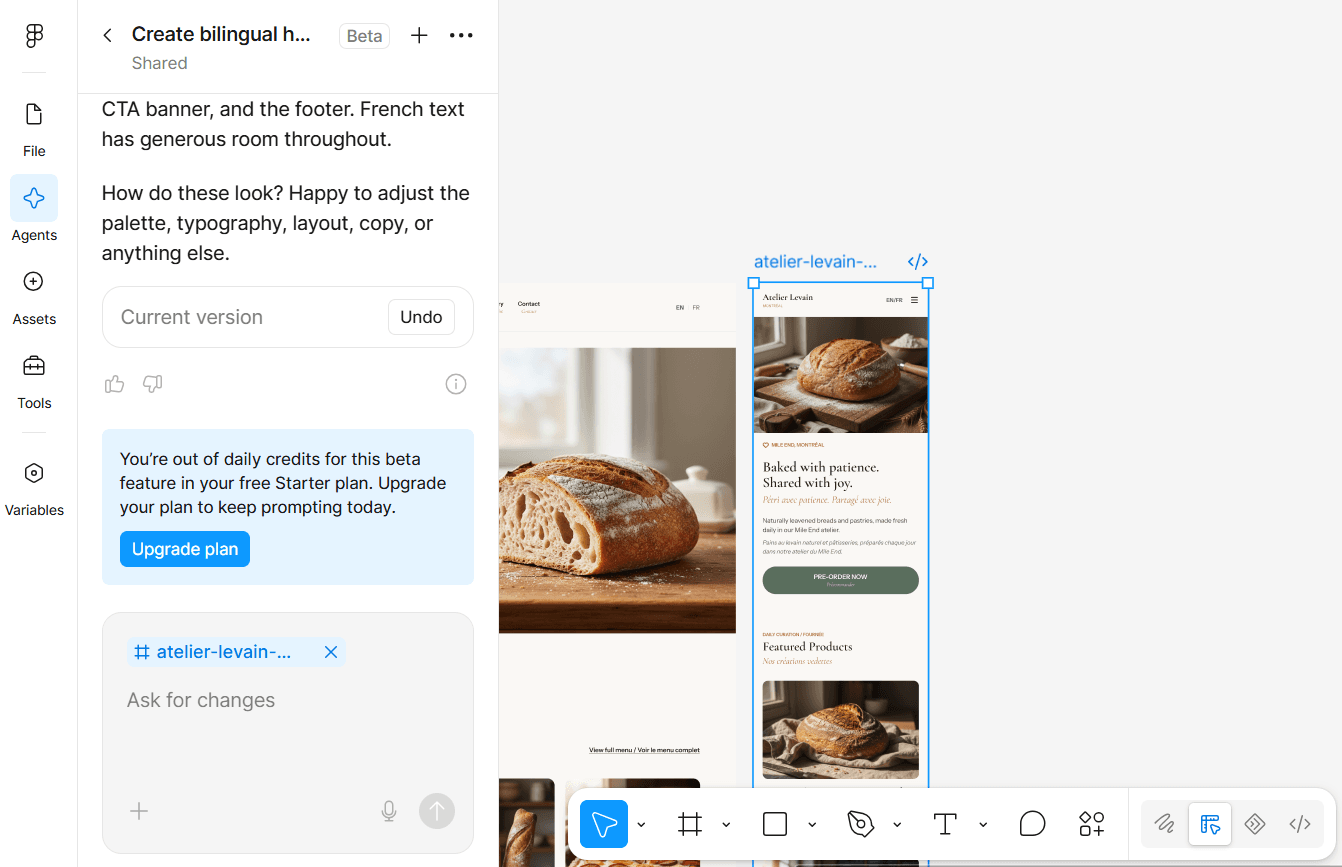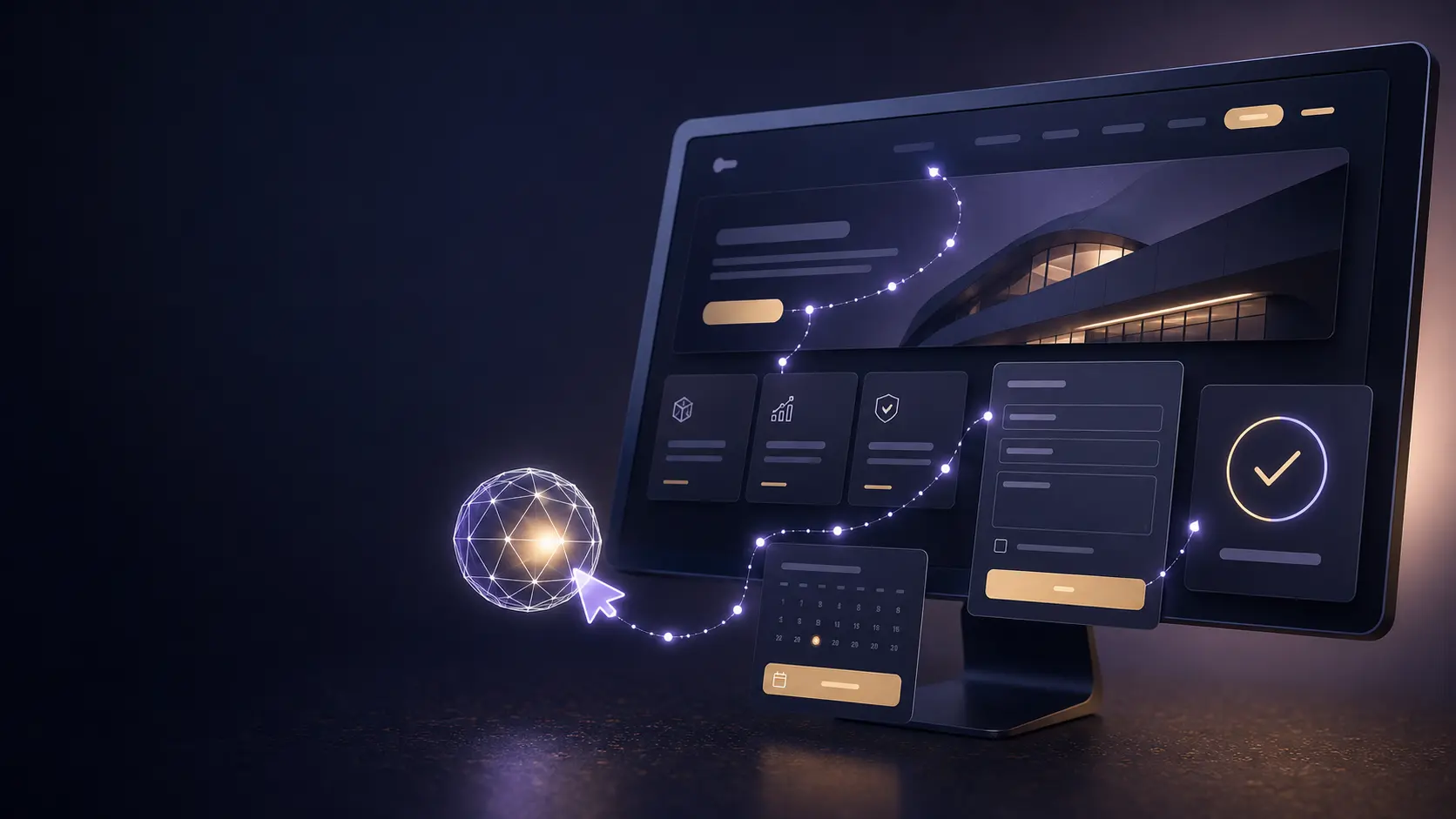

AI agents are moving beyond answering questions. They can open websites, compare options, navigate menus, fill in forms and complete multi-step tasks. That creates a new question for every business owner: if a potential customer asks an AI agent to use your website, will it succeed?
The answer depends on more than search rankings. An agent might discover your business in a search result and still fail when it reaches an unclear menu, an unlabelled form field or a pop-up that blocks the page.
The practical lesson is simple: a website that is clear, accessible and predictable for people gives AI agents a much better chance of understanding it and completing a task. There is no special “agent SEO” shortcut that replaces good website fundamentals.
What makes a website usable by AI agents?
Use this table as a quick first check.
| Website element | Good for people and agents | Common failure |
|---|---|---|
| Navigation | Clear labels such as Services, Pricing and Contact | Icon-only menus or vague labels |
| Buttons | Descriptive actions such as Book a Consultation | Buttons labelled Click Here or Learn More without context |
| Forms | Visible labels, instructions and useful error messages | Placeholder-only fields or custom controls with no accessible name |
| Business information | Consistent services, location, hours and contact details | Important details scattered across several pages |
| Dynamic content | Essential information appears in the rendered page and remains keyboard accessible | Content hidden behind hover effects, carousels or fragile scripts |
| Confirmation | Clear success message and next step | The page changes silently after an action |
| Structured data | Accurate markup that matches the visible page | Missing, incomplete or misleading schema |
If your website fails several of these checks, the problem is not only an AI problem. Customers using keyboards, screen readers, small screens or slow connections may be struggling too.
AI visibility is not the same as AI usability
Three different systems are often grouped together under “AI visibility,” but they do different jobs.
AI crawlers discover information
Crawlers collect content that may support search, training or product features. OpenAI, for example, documents separate user agents for search discovery, model training and user-initiated visits. A crawler reaching your page does not mean an action-taking agent can successfully use your interface.
AI answer engines interpret and recommend
Search and answer tools may summarize your services, compare your offer with competitors or cite your content. They need accurate, crawlable information and trustworthy evidence. They do not need to press every button on the page.
AI agents navigate and act
Action-taking agents must interpret the live interface, decide what to click, handle changes and determine whether the task succeeded. OpenAI’s computer-use documentation describes this as a repeated cycle: inspect the interface, return actions, receive a new screenshot and continue until the task is complete.
This final stage is where many visually attractive websites become difficult. A human may infer that a floating icon opens the booking form. An agent may not understand the icon, may click the wrong layer or may never recognize that a submission succeeded.
What AI agents may do on a business website
An agent does not need to make a purchase to influence a customer’s decision. Common tasks already include:
- Finding a company’s main service and service area
- Comparing two packages or providers
- Checking prices, availability, hours or policies
- Locating a phone number, email address or booking page
- Completing a contact or quote form without submitting it
- Adding a product to a cart for the user to review
- Gathering evidence for a recommendation
- Confirming what happens after a form, booking or purchase
The website therefore needs to support two moments: understanding the offer and completing the next step.
Seven reasons an AI agent may fail on your website
1. Buttons do not explain their purpose
Icon-only controls, several identical “Learn More” links and buttons without accessible names create ambiguity. W3C accessibility guidance requires controls to have meaningful names, while MDN notes that icon-only buttons need a concise accessible name. Descriptive controls help screen-reader users, voice-control users and agents identify the intended action.
2. Forms rely on placeholders instead of labels
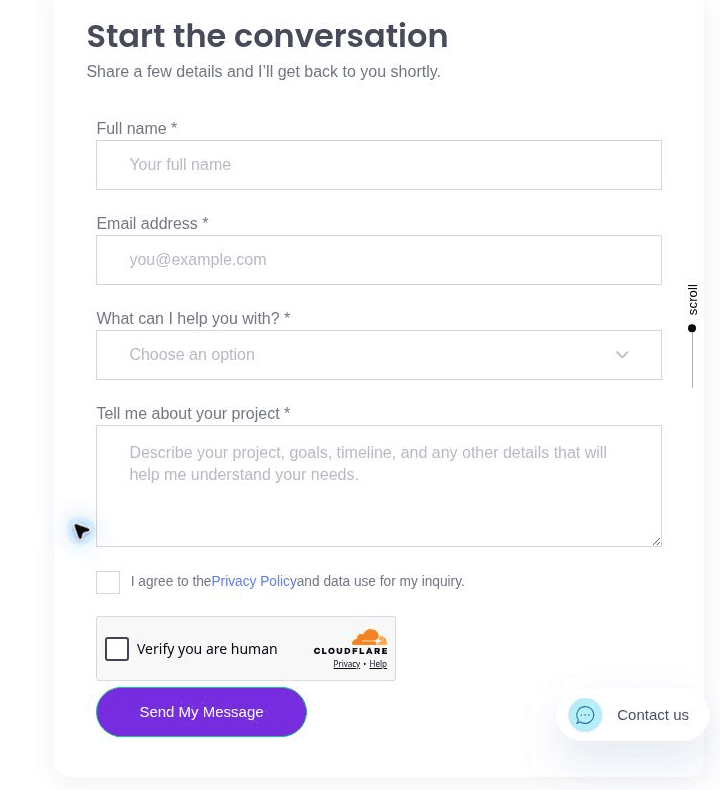
A placeholder disappears when someone starts typing and may not be programmatically connected to the field. W3C recommends identifying every text field, checkbox, radio button and dropdown with a proper label. Clear labels also help an agent match information such as an email address or project budget to the correct field.
3. Pop-ups interrupt the task
Cookie banners, newsletter overlays, chat boxes and promotional pop-ups can cover navigation or change the page layout. People usually close them instinctively. An agent may spend several actions finding the close control—or stop if the control is unclear.
4. Important information is hidden behind interaction
If pricing, policies or service details appear only after hovering, dragging a carousel or opening a custom accordion, some agents may miss them. Essential decision-making information should remain available in the rendered page and be reachable with a keyboard.
5. Services and business details are inconsistent
An agent cannot confidently compare your business when the homepage uses one service name, the contact page shows another location and your Google Business Profile lists different hours. Consistency across your website, profiles and structured data reduces uncertainty for both customers and AI systems.
6. The interface depends too heavily on visual context
A beautiful portfolio image can demonstrate quality, but an image alone does not explain the project, result or service. Use meaningful alt text where appropriate and support important visuals with short, visible explanations.
7. The website does not confirm success
After a form or booking action, the agent needs a reliable signal: a confirmation heading, reference number, next-step message or visible status change. A subtle colour shift is not enough. Without a clear confirmation, the agent may repeat the action or report that it could not verify completion.
The five-minute AI-agent readiness test
You do not need to let an agent buy something or submit private information. Start with a public, reversible test.
Step 1: Choose a realistic task
Ask the agent to find your primary service, identify the area you serve, compare two offers, locate contact information and explain the next step for becoming a customer.
Step 2: Set a safe stopping point
Tell the agent not to submit a form, sign in, make a purchase or share personal information. It may fill a form with obvious test data only if you control the page and explicitly authorize that action.
Step 3: Watch where it hesitates
Record the first wrong click, repeated action, misunderstood label or missing detail. The failure point is more useful than a simple pass or fail.
Step 4: Repeat on mobile and desktop
Responsive layouts often change menus, button positions and pop-up behaviour. An agent that succeeds on desktop may fail on the mobile version.
Step 5: Verify the answer manually
Check every service, price, location and policy the agent reports. A fluent answer can still contain a wrong assumption.
Use this safe prompt:
Review this website as a potential customer. Find the main service, service area, contact details and the steps required to request a consultation. Compare two relevant services if available. Do not sign in, submit a form, make a purchase or share personal information. Report every point where the navigation, labels or confirmation are unclear.
What the test revealed on zahraali.ca
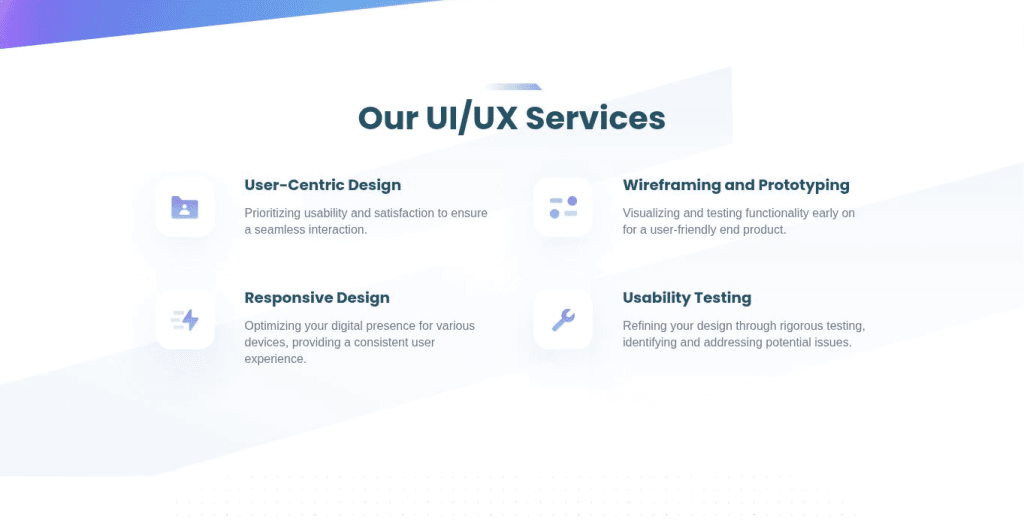
I asked an AI agent to find my UX/UI Design service, identify two things I offer and locate the correct contact form for starting a UX/UI project. It had to stop before entering personal information or submitting anything.
The test exposed one friction point: a homepage “Learn More” control did not lead to the UX/UI service page. The agent recovered by locating the service through the site’s navigation structure.
AI-agent website scorecard
Rate each area from one to five, then investigate anything below four.
| Area | Five-star standard |
|---|---|
| Discoverability | Important pages can be found and crawled |
| Content clarity | Services, audience, location and next steps are explicit |
| Navigation | Links and menus use descriptive, predictable labels |
| Form usability | Every control has a label, instructions and useful errors |
| Structured information | Schema is valid, accurate and matches visible content |
| Accessibility | Keyboard navigation, focus, headings and accessible names work |
| Task confirmation | Success, errors and next steps are unmistakable |
Do not treat the total as a universal technical score. It is a practical way to compare tests over time and identify the part of the journey that needs work.
Which AI agent can use websites best in 2026?
There is no universal winner. The strongest choice depends on whether you need general web actions, developer testing, background work, logged-in automation or research. The ratings below are editorial judgments based on documented capabilities and availability as of August 2026, not independent benchmark results.
| AI agent | Best use case | Editorial rating | Important limitation |
|---|---|---|---|
| ChatGPT Browser | Best all-around option for research, website actions, files and connected work | 4.5/5 | Availability and browser features vary by ChatGPT surface and plan |
| Claude in Chrome and Cowork | Best for developers testing and debugging websites | 4.5/5 | Chrome interaction requires a paid plan; the browser extension remains beta |
| Gemini in Chrome and Gemini Spark | Best for Google apps, scheduled work and multi-step Google workflows | 4/5 | Some agent and auto-browse features are limited by plan, region or preview rollout |
| Manus Browser Operator | Best for autonomous work in existing logged-in browser sessions | 4/5 | Requires broad browser access and careful monitoring on sensitive sites |
| Perplexity Comet and Computer | Best for research-heavy workflows, monitoring and sourced reports | 4/5 | Advanced autonomous features and higher limits depend on subscription level |
Best all-around: ChatGPT Browser
ChatGPT Browser can open websites, gather current information and take actions while the user stays in control. It is a strong choice when one task combines web research with files, connected tools and a finished deliverable. OpenAI recommends keeping a human involved for purchases, authenticated workflows and actions that are difficult to reverse.
Best for website developers: Claude in Chrome and Cowork
Claude in Chrome can interact with websites and, when connected to Claude Code or Desktop, inspect developer-oriented information such as console errors, network requests and DOM state. That makes it especially useful for testing a page, reproducing a bug and checking the result after a code change. Anthropic also warns that browser agents remain exposed to prompt-injection risk.
Best for the Google ecosystem: Gemini in Chrome and Gemini Spark
Gemini in Chrome supports multi-step auto-browse tasks and connects with services such as Gmail, Calendar, Maps, Shopping and Flights. Gemini Spark extends that idea to background tasks, schedules and reusable skills. Google’s current documentation notes that some agentic features remain limited to eligible plans, regions or previews, so availability must be checked before recommending it to every user.
Best for autonomous logged-in workflows: Manus Browser Operator
Manus Browser Operator works inside the user’s existing browser session and can plan, navigate, click and complete multi-step tasks across sites. This makes it useful for workflows involving authenticated tools, but it also means the agent may see and act inside sensitive accounts. The user must authorize each session and should supervise complex work.
Best for research-heavy agent work: Perplexity Comet and Computer
Comet Agent can fill forms and complete multi-step browser workflows, while Perplexity Computer is designed for longer-running research, documents, code and connected tools. Its strongest fit is work where sourcing, monitoring and research quality matter as much as browser interaction.
How to make your website easier for humans and agents
Use semantic HTML and a logical heading hierarchy
Use one H1 for the page topic, followed by properly nested H2 and H3 sections. Use real buttons for actions, real links for navigation and native form controls where possible. Semantic elements give browsers and assistive technologies useful information without extra interpretation.
Write descriptive links and buttons
“View UX/UI Services” is more useful than “Learn More.” “Book a 30-Minute Consultation” is clearer than an unlabelled calendar icon. A visible label should also match or appear within the control’s accessible name.
Label every form field
Keep visible labels above or beside fields, group related options, explain required formats and provide specific errors. Do not rely only on colour or placeholder text.
Make essential content available without fragile interactions
Hover effects and animation can enhance a design, but essential information should not depend on them. Test menus, tabs, filters, accordions and carousels with a keyboard and on a small screen.
Keep business information accurate everywhere
Use the same business name, service descriptions, location, hours and contact details across important pages and profiles. If you add structured data, Google requires it to accurately represent the visible content.
Add unmistakable success and error messages
Tell the user exactly what happened and what comes next. For example: “Your consultation request was received. We will reply within two business days.” Keep the confirmation visible long enough to be detected.
Reduce unnecessary obstructions
Review every cookie banner, chat window, promotion and newsletter pop-up. Ensure the close control is labelled, keyboard accessible and does not cover the main task on mobile.
The safety problem businesses cannot ignore
Browser agents can encounter malicious instructions hidden inside websites, emails or documents. This is called indirect prompt injection. Both OpenAI and Anthropic advise treating page content as untrusted and keeping people involved for sensitive or irreversible actions.
Business owners should never test agents with customer records, payment details or private accounts. Use a staging environment or public pages, set explicit limits and stop before submission. A successful test proves that a normal task can be completed; it does not prove that every agent will behave safely on every page.
My experience using an AI agent to improve my website’s SEO
I tested an AI agent on my own website, zahraali.ca, rather than relying only on product demonstrations. I asked it to review important pages, identify SEO problems, explain what needed attention and help me work through approved fixes one step at a time.
The agent identified issues such as an unclear homepage H1, inconsistent heading levels, weak keyword focus, limited internal linking, portfolio SEO gaps and an authorship inconsistency between “Zahra Ali” and “Zahraa Ali.”
What the AI agent did well
It helped me inspect many pages faster, organize problems by priority and translate technical findings into practical WordPress tasks. It was particularly useful for checking headings, metadata, indexing settings, page structure and content opportunities.
Where I still needed human control
I did not allow the agent to change everything automatically. I reviewed recommendations before approving them because an agent can misunderstand a page, suggest unnecessary changes or overlook how the design, content and website system work together.
The result
The immediate result was a clearer SEO plan and several approved page-level improvements without rebuilding stable parts of the website. The process also reduced the time required to inspect the site manually.
I cannot honestly claim an increase in rankings or organic traffic yet. Those results take time and must be verified through Google Search Console and analytics. My experience showed that an AI agent can make SEO work faster and more organized, but it still needs accurate data, careful verification and human supervision.
Build for clear, safe and complete tasks
AI-agent readiness is not a separate design trend. It is a new reason to improve fundamentals that already matter: clear information, semantic structure, accessible controls, consistent business details, predictable navigation and strong confirmation messages.
Do not redesign your website for a hypothetical robot. Test realistic tasks with one or two current agents, record the exact failure points and fix the barriers that also affect real customers. The websites most likely to work well for AI agents are usually the websites that are easiest for people to understand and use.
Official sources
- OpenAI: Browser
- OpenAI: Computer use
- OpenAI: Web crawlers and user agents
- Anthropic: Use Claude in Chrome safely
- Google: Gemini in Chrome auto browse
- Google: Gemini Spark
- Manus: Browser Operator
- Perplexity: Comet for Enterprise
- W3C: Labeling form controls
- Google Search Central: Structured data guidelines
Need help applying these ideas to your website?
I help businesses improve their UX/UI, content structure and digital experience. Tell me about your project.