

On July 6, 2026, Public Services and Procurement Canada launched the first measures under its new Small Business Procurement Program. The changes are intended to reduce administrative burden, make federal opportunities easier to understand and help more Canadian small businesses participate in procurement.
For owners searching for government contracts for small business in Canada, this is a timely reason to learn the federal process and review how clearly the business presents its services and experience.
That preparation starts with CanadaBuys, not with a website. Registration, submission instructions, eligibility and evaluation criteria come from the specific tender and official Government of Canada sources. A professional website, company profile or proposal design can support a credible business presentation, but it does not qualify a supplier or guarantee a contract.
What changed in Canada’s Small Business Procurement Program in July 2026
The July 6 announcement from Public Services and Procurement Canada introduced a phased set of measures under the Small Business Procurement Program.
Phase 1 begins in summer 2026. It includes procurement requirements designed with small-business capacity in mind, an enhanced Procura chatbot for on-demand guidance and wider use of standardized solicitation and contract templates.
The government’s Small Business Procurement Program backgrounder says Phase 2 is planned by the end of 2026. Planned measures include plain-language tender summaries, reusable common attestations and documents through a “Tell Us Once” approach, structured response formats, pre-submission completeness checks and a supplier-recognition program.
The official backgrounder defines a small business as a company with 499 employees or fewer, including employees of its affiliates. A joint venture’s combined employee total must also be no more than 499.
This rollout is connected to, but distinct from, the broader Buy Canadian Procurement Policy Framework, which took effect on December 16, 2025. The July 2026 measures specifically address barriers small businesses face when participating in federal procurement.
The minimum procurement pathway to understand
CanadaBuys is the official starting point for businesses learning how to sell to the federal government. Its Preparing to sell to the government page was updated on July 27, 2026.
The basic pathway has five steps:
- Register and complete the business profile. For opportunities posted by Public Services and Procurement Canada, suppliers need an SAP Business Network account. CanadaBuys also directs businesses to complete their company profile and the required Government of Canada questionnaire before bidding.
- Find and follow opportunities. Search CanadaBuys tender notices using accurate terms for the goods or services your business provides. Follow relevant searches or notices for updates.
- Read the complete tender. Review the scope, mandatory requirements, required forms, submission method and deadlines before preparing a response.
- Prepare and submit as instructed. Each opportunity can have different requirements. Address every requested item and use the submission method stated in the tender.
- Understand the evaluation. Bids are assessed against the criteria published in that tender. If the result is unsuccessful, suppliers can request a debrief after a competitive process.
Use the official CanadaBuys guidance on business registration, finding tender opportunities, bidding and bid evaluation for the current instructions.

Where a professional website can support supplier credibility
Formal evaluation follows the tender’s published criteria. A website is supporting communication, not a substitute for the bid, and a buyer may not visit it unless the process makes it relevant.
Even so, a clear website can help potential partners, referral sources and other visitors understand who you are, what you provide and how your experience fits. It also gives your team a reliable source of approved company information when preparing business materials.
Clear company identity and contact information
Visitors should be able to identify the business behind the website. Present a consistent company name, location or service area, professional contact method and concise description of what the company does.
Avoid broad claims that are difficult to verify. Specific information is easier to trust and reuse. Keep staff details, contact information and business descriptions current across the website and company materials.
Focused service and capability pages
Each important service page should explain the problem the service addresses, what the work includes and which project types or industries the team understands. Include only qualifications, standards and capabilities the business can support with evidence.
UX/UI design for a clearer supplier website can improve information structure, navigation and readability. The purpose is not to copy tender language into marketing pages. It is to help a qualified visitor understand the company without decoding vague claims.
Relevant case studies
Case studies can show how a business approaches real work. A useful case study explains the context, the company’s role, the work completed and the result without exposing confidential information or exaggerating outcomes.
For example, the Cybertivity cybersecurity website project demonstrates how a specialized service can be organized and communicated through a focused web experience. A portfolio page does not prove procurement eligibility, but it can make relevant experience easier to understand.
For each published example, keep an internal source record with the project dates, scope, team role, client approval and evidence behind any result. This makes it easier to distinguish a supported fact from a marketing summary when proposal work begins.
The website, company profile and proposal materials should also agree on basic facts such as the business name, services, team capacity and relevant experience. Consistency does not replace tender evidence, but it reduces avoidable confusion. When a tender asks for a specific format or proof, use that requirement rather than copying a marketing case study into the bid.
Trust, usability and accessibility
Maintain HTTPS, working forms, readable page structure and accurate privacy information for the data the website collects. Remove broken links, outdated profiles and unsupported certification claims.
Accessibility requirements can appear in federal procurements where appropriate, particularly when accessible goods, services or digital deliverables are part of the requirement. This does not create one universal compliance rule for every supplier website. Still, an accessible and usable website reduces barriers for visitors and communicates care in how information is presented.
English and French content can also be useful where the audience, service environment or opportunity makes it relevant. It should not be presented as a universal qualification. The tender determines the actual language requirements.
Businesses with outdated or difficult-to-maintain pages can use website management and improvement support to strengthen the reliability of the information they publish.
Capability overviews, company profiles and proposal materials
An optional capability overview or company profile can organize information for introductions, partner discussions and proposal preparation. It may include the company’s identity, core services, relevant sectors, selected experience, delivery capacity, verifiable qualifications and contact information.
This is presentation material, not proof of procurement eligibility. It does not replace registration, mandatory forms or a tender-specific response.
Strong information hierarchy and consistent design make the document easier to scan. Zahra Ali’s Nexus company profile design shows one way to organize a business story into a professional document. Businesses that need similar material can explore professional company-profile design.
Government supplier digital-readiness checklist
Before pursuing an opportunity, review these public-facing business basics:
- Identity and contact: Use a consistent company name, clear service area and monitored contact method.
- Service descriptions: Explain the main services, scope and delivery limits in plain language.
- Relevant proof: Publish accurate case studies or experience summaries without confidential information.
- Optional business materials: Keep the company profile or capability overview current and consistent with the website.
- Accessibility and usability: Check navigation, headings, contrast, forms and readability, then review the tender for any specific requirements.
- English and French where relevant: Maintain accurate content in both languages when it supports the audience or opportunity.
- Privacy, security and trust: Maintain HTTPS, appropriate privacy information, working forms and verifiable claims.
- Proposal materials: Use clear, accessible templates while following the tender’s required format exactly.
Mandatory checklist disclaimer: This checklist supports business presentation and digital preparation. It does not determine eligibility, replace CanadaBuys registration, or satisfy tender requirements.

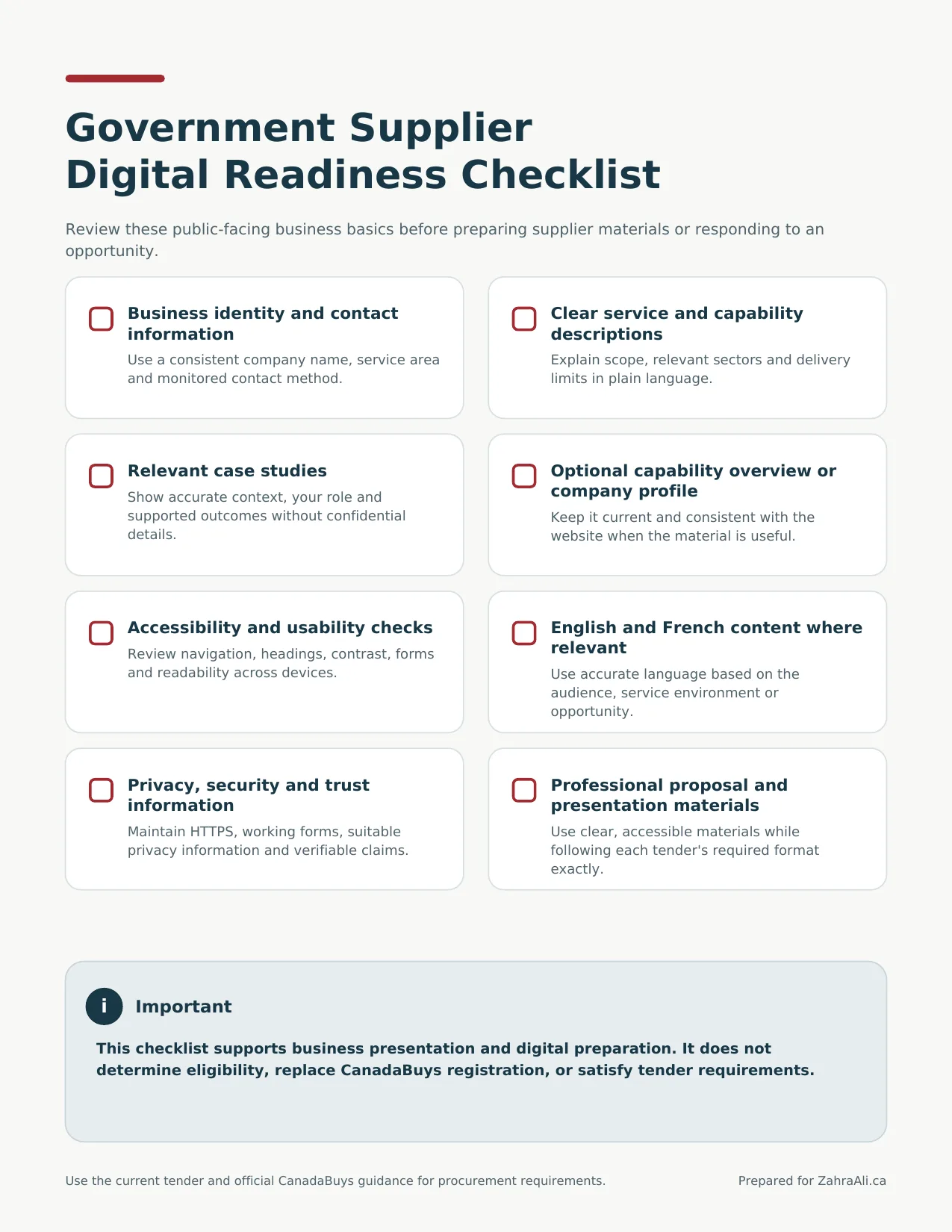
Download the digital-readiness checklist
What digital readiness cannot do
A polished website or company profile cannot replace registration, mandatory forms, certifications, security conditions or technical evidence. It cannot correct a late or incomplete bid, guarantee that a buyer will review the website or guarantee a contract award.
Digital readiness helps a business present accurate information consistently. Procurement readiness still depends on finding a suitable opportunity, reading the tender carefully, proving the required qualifications and submitting a compliant response.
Next steps for Canadian small businesses
Start with the official CanadaBuys preparation guidance, complete the required registration steps and search for opportunities that match your real services and capacity. Then review whether your website, case studies and supporting materials communicate those capabilities clearly and accurately.
If your website, UX or company profile needs a clearer structure, Zahra Ali can help improve how your business communicates its work without suggesting that design determines eligibility or contract success.
Frequently asked questions
Where can Canadian small businesses find federal procurement opportunities?
CanadaBuys is the official place to search federal tender notices and learn about registration and bidding. Always follow the instructions in the specific tender because submission requirements can differ.
Is a website required to sell to the Canadian government?
The tender and CanadaBuys registration process determine what is required. A website is not a substitute for either. It can support business presentation by making services, experience and contact information easier to understand.
Is a capability overview or company profile required?
Not universally. It is optional business presentation material unless a tender specifically requests it. The document should never be presented as proof of eligibility or used instead of the required bid response.